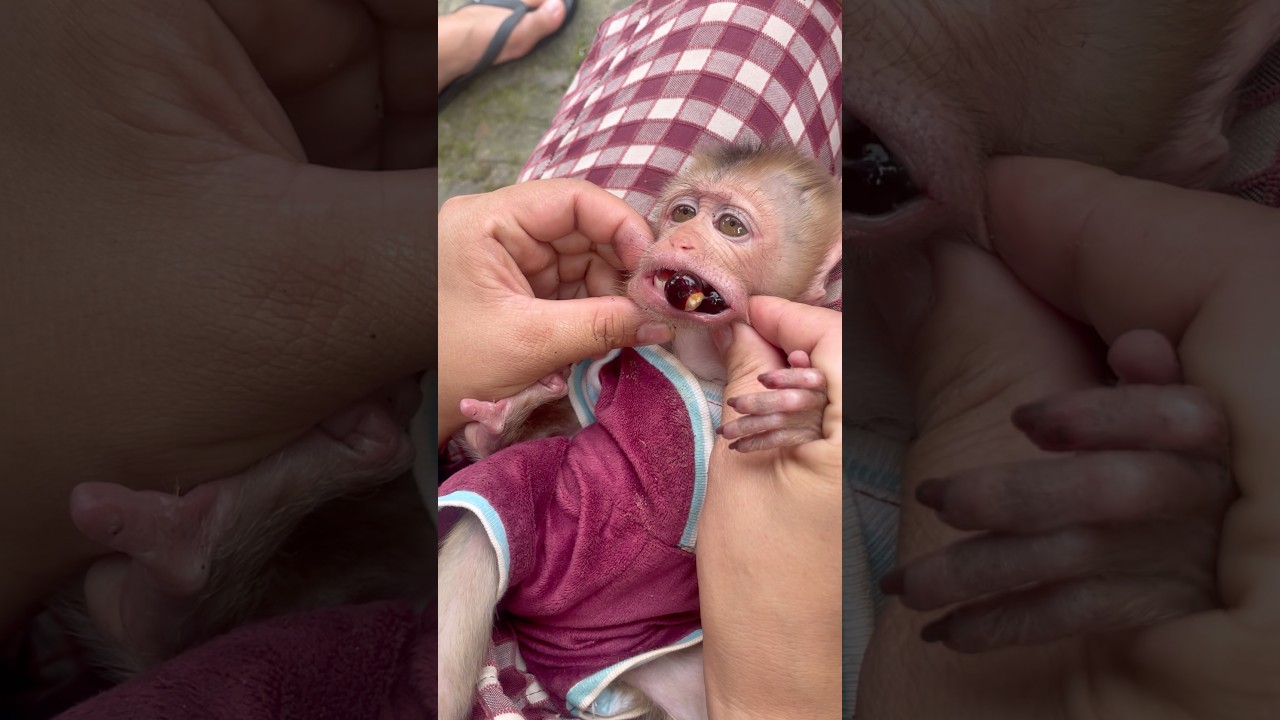
A short video making the rounds online shows a small monkey, dressed in a baby’s maroon-and-white outfit, sitting on an adult’s lap while a pair of hands pries open its mouth. In the clip’s final frame, something dark and glistening sits visible between the animal’s teeth before it’s worked free. The caption that travels with the clip frames it simply: the baby monkey had something stuck, and “Mom” got it out.
That is the full story the video itself tells. It’s also worth understanding what it doesn’t tell — and why that gap matters for anyone scrolling past these clips.
What the footage actually shows
Across the still frames available from the video, a young monkey — small enough to fit easily across an adult’s forearms, with light fur and the rounded face typical of an infant primate — is seated on someone’s lap atop a red-and-white checked cloth. A pair of human hands, fingers positioned at the corners of the animal’s mouth, holds the jaw open. The monkey’s eyes are wide and its expression strained as the hands work at something inside its mouth. In the closing frame, a dark, wet-looking object is visible between its teeth.
No narration, description, or caption text was available to confirm what the object is, how it got there, or where the animal was before the camera started rolling. The video runs as a short-form clip with no accompanying explanation beyond its title.
Who is behind the channel
The video comes from a channel called Benny the Baby Monkey, which describes itself as following a “playful, adorable baby monkey” on daily adventures that include playing, learning, cuddling, and eating bananas. The channel promises new videos every week, along with feeding-time clips and life updates, and brands itself as family-friendly content.
That framing — a single named baby monkey, dressed in human infant clothing, filmed in frequent close-up interactions with an adult caregiver — is a format that has become extremely common on YouTube, Facebook, and TikTok over the past several years. It is also a format that has drawn sustained scrutiny from animal-welfare researchers.
Why these videos have come under scrutiny
Starting in 2021, a coalition of animal protection groups called the Social Media Animal Cruelty Coalition, or SMACC, began systematically reviewing monkey content across major platforms. Their first major investigation, covering videos posted between September 2021 and May 2023, found that videos by pet macaque owners had a total of 12.05 billion views online, with 12 percent of these videos involving intentional physical torture, 13 percent involving psychological abuse, and 60 percent involving direct physical abuse.
A separate SMACC report published in 2024 looked specifically at videos showing macaques being bathed, dressed in clothes, or ‘rescued’ that were shared across multiple social media platforms, including Facebook, YouTube, and TikTok. That report found several fake macaque rescue videos which involved deliberately putting the animal’s life at risk and then “rescuing” them from these manufactured situations, a pattern researchers say is built specifically to generate dramatic, shareable moments.
Crucially, the groups behind these reports say the harm isn’t limited to videos with obvious violence. Experts agree that keeping primates as pets is inherently cruel, and results in a multitude of issues that severely compromise their welfare — the report concludes that ‘pet’ monkey videos, whether intentionally or not, are profoundly harmful. In other words, a video doesn’t need to show overt cruelty to represent a welfare problem; a wild animal being kept, dressed, and handled as a human-style pet carries its own costs for the animal, researchers argue.
Separately, more extreme findings have drawn law enforcement attention. A BBC World Service investigation uncovered private groups in which members paid to have monkeys tortured on camera, leading to arrests. At least 20 people in the United States and two in Indonesia were placed under investigation, including an Oregon man who was indicted in June 2023. That investigation involved videos far more graphic than anything in the clip discussed here, but it illustrates how seriously regulators and platforms now treat this content category.
What can’t be confirmed about this particular video
None of this means the Benny clip is part of that darker pattern — there is no evidence tying this specific channel to torture content, fake-rescue staging, or any of the cases referenced above. What can be said is that the video sits inside a genre that independent researchers have flagged as worth watching closely, precisely because so much of it looks identical to ordinary pet content on the surface.
Several basic facts about this clip remain unconfirmed. The animal’s exact species isn’t stated on the channel; based on appearance and the broader pattern of this content category, it resembles a young macaque, the species most commonly used in these videos. It’s also not clear who the adult handling the animal is, where the video was filmed, what the object in the monkey’s mouth actually was, or whether the animal was examined by anyone with veterinary training afterward. The title’s reference to “Mom” appears to be the channel’s affectionate shorthand for the human caregiver rather than a claim that the animal’s biological mother is present in the footage.
What responsible viewing looks like
Animal welfare groups that track this content don’t typically ask viewers to assume the worst about every cute-looking clip. Instead, their guidance is more practical: be skeptical of videos that closely follow familiar emotional beats — a baby animal in apparent distress, a dramatic rescue, a happy resolution — especially when a channel posts this kind of content on a weekly schedule and monetizes it. Fake rescue content not only puts animals at risk but also undermines the work of legitimate rescue organizations, researchers note, which is part of why platforms have been pushed to apply more scrutiny to the genre as a whole.
For now, the clip itself shows exactly what it shows: a young monkey, a pair of human hands, and a moment of apparent relief once whatever was caught in its mouth comes free. The broader questions — about where this animal came from, how it’s kept, and whether moments like this one are as spontaneous as they appear — are not ones the video answers.
Key takeaway
Cute, close-up animal clips like this one are enormously popular, but the “pet macaque” genre they belong to has drawn years of documented concern from animal welfare researchers, who say even the gentlest-looking videos can reflect a wild animal being kept in conditions that don’t serve its wellbeing. Enjoying a clip doesn’t require ignoring that context.
[“baby monkey video”, “pet macaques”, “animal welfare”, “social media animal cruelty”, “smacc report”, “viral animal videos”, “youtube monkey content”]
Animals
documentary
[“The video is posted by a channel called Benny the Baby Monkey, which describes its content as following a baby monkey’s daily adventures.”, “Still frames show a young monkey in an infant-style outfit having its mouth held open by an adult’s hands, with an object visible in its mouth in the final frame.”, “SMACC’s research found that pet macaque videos analyzed from 2021-2023 totaled 12.05 billion views, with 60% showing direct physical abuse.”, “A 2024 SMACC report found multiple staged ‘fake rescue’ videos involving macaques across Facebook, YouTube and TikTok.”, “A BBC investigation into a separate, more extreme monkey-torture video ring led to at least 20 people in the U.S. being placed under investigation.”]
[“The exact species of the monkey in the video (assumed to resemble a macaque based on appearance and genre patterns, not confirmed)”, “The identity, location, or relationship of the adult handling the animal”, “What the object in the animal’s mouth actually was”, “Whether the depicted event was spontaneous or staged in any way”, “Whether this specific channel has any connection to the abusive or fake-rescue content documented by SMACC, Action for Primates, or the BBC investigation — no such connection is implied or confirmed”, “Whether the animal received any veterinary attention after the incident shown”]
[“documentary”, “educational”, “seo”]
The material is a short, captionless animal clip best served by careful observational description paired with verified context about the well-documented online genre it belongs to.
A young monkey in an infant outfit has its mouth held open by an adult’s hands in the viral clip.
A young macaque monkey sits calmly on a tree branch in a lush green forest, soft natural daylight filtering through leaves, fur detailed and expression gentle and alert. The composition is a wide editorial wildlife shot emphasizing the animal in its natural habitat, warm and calm mood, no people, no text, no logos.
Young macaque monkey resting on a branch in a green forest setting
What a Viral ‘Baby Monkey’ Video Doesn’t Tell You
A short clip of a young monkey having something removed from its mouth has been making the rounds. It’s part of a video genre that animal welfare researchers have studied closely for years — and their findings add real context to what looks like a simple, sweet moment on screen.
[“How researchers identify staged ‘animal rescue’ videos on social media”, “What it means, legally and ethically, to keep a macaque as a pet in Southeast Asia”, “Inside SMACC: the coalition tracking animal cruelty content across platforms”, “Why baby-animal content performs so well with social media algorithms”]
[“Benny the Baby Monkey — YouTube channel page”, “Monkey abuse: the cruelty behind social media videos — World Animal Protection (worldanimalprotection.org.au)”, “Monkey hate — Wikipedia summary of SMACC 2021-2023 study”, “Monkey abuse videos on the rise as social media policies fail to protect animals — World Animal Protection”, “New report exposes dangerous fake animal rescues on social media — World Animal Protection UK”, “Cambodia grapples with rise of YouTubers abusing monkeys for clicks at Cambodia’s Angkor world heritage site — CBS News”]

4 Comments on “Oh No, the Little Monkey Got Something Stuck in Its Mouth, and Mom Helped It Get It Out”