
In the world of social media wildlife clips, few scenes capture human hearts faster than an infant animal resting in miniature comfort. A viral eight-second YouTube Short titled “To keep Xuxu warm while she slept, her mother picked leaves and placed them on her.💋”—published by channel Thuyền Trưởng XSMB and available at http://www.youtube.com/watch?v=AfxgBXhCCXE—presents a snapshot of a tiny infant macaque curled up in a makeshift bed crafted from dry forest leaves.
Surpassing half a million views, the clip exemplifies the intersection between animal vulnerability, primate nesting biology, and the curated storytelling that drives modern digital media.
The Eight-Second Scene: A Miniature Bed in the Wild
Despite its short length, the video presents a neatly composed visual vignette that feels straight out of a storybook:
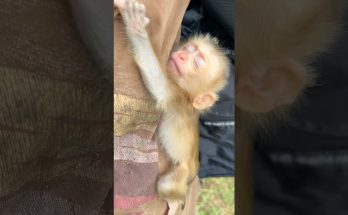
- [00:00] – The Leaf Hammock: A newborn macaque, named Xuxu in the creator’s running series, lies fast asleep on the forest floor. Instead of resting directly on the damp soil, the infant is cradled inside a curved, dried bamboo or palm sheath acting as a natural bassinet.
- [00:02] – The Sleeping Posture: The infant displays classic newborn behaviors: curled in a fetal position, eyes tightly shut, with a tiny hand resting softly against her cheek and mouth, reminiscent of a human baby sucking its thumb.
- [00:04] – Tucking In: A human hand enters the frame holding a second matching dried leaf sheath. Gently and deliberately, the caretaker slides the broad, fibrous leaf over the infant’s lower body, swaddling the monkey like a sleeping bag.
- [00:06] – Quiet Repose: With the leaf tucked securely over her shoulders, only Xuxu’s tiny face remains visible. The infant remains fast asleep, framed by green sprouts and dry foliage while a soft, soothing lullaby hums in the background.
Primate Thermoregulation: Why Warmth Is a Matter of Survival
While the video is framed as a whimsical, cozy moment, the underlying biological need for temperature regulation in newborn primates is critical.
In early infancy, primates—including macaques (Macaca)—face significant physiological hurdles:
- High Surface-Area-to-Volume Ratio: Due to their small body mass, infant monkeys lose core body heat rapidly to their surrounding environment.
- Minimal Subcutaneous Fat: Unlike aquatic mammals or adult primates, newborns possess very little insulating body fat and cannot maintain homeostatic warmth independently in cold or damp conditions.
- Reliance on Maternal Contact: In wild troops, young macaques do not sleep tucked under ground vegetation. Instead, they cling tightly to the mother’s chest or abdomen, absorbing direct conductive heat from her skin and fur. When ambient temperatures drop, wild troop members form dense sleeping clusters known as “huddling balls” to share thermal energy.
In hand-rearing or domestic settings, caretakers often substitute maternal body heat with heating pads, fleece blankets, or—as shown in the clip—warm, insulating organic materials like dry foliage.
The Art of Staged Storytelling in Short-Form Media
The title of the video—attributing the leaf blanket to the infant’s “mother”—highlights the narrative framing typical of viral pet content:
| Feature | Portrayed Social Media Narrative | Biological & Practical Reality |
| Bedding Construction | An attentive animal mother gathers natural blankets. | Arranged by a human caretaker for aesthetic and protective purposes. |
| Sleep Location | A natural nap on the forest floor. | Wild primates avoid sleeping exposed on ground leaf litter due to ground predators and insect bites. |
| Infant Reaction | Peaceful, undisturbed fairy-tale slumber. | Reflects deep fatigue or accustomed habituation to human handling and staging. |
By translating an infant primate’s nap into human terms—sleeping in a bed, covered by a blanket, tucked in by a “mother”—the creators tap into universal cultural concepts of nursery comfort and parental devotion.
Why the Image of a Sleeping Infant Resonates
The scene in http://www.youtube.com/watch?v=AfxgBXhCCXE appeals directly to human evolutionary psychology. Ethologist Konrad Lorenz famously identified the Kindchenschema (baby schema)—a cluster of physical features such as large foreheads, small snouts, and diminutive bodies that involuntarily trigger affection and protective instincts in adults.
When combined with universal imagery of swaddling and sleep, the sight of a tiny primate nestled beneath a leaf circumvents cultural and linguistic barriers. It reminds viewers of the fragile beginnings shared by all primate life, offering a quiet, restful moment in an otherwise chaotic digital stream.



One Comment on “Nature’s Blanket: The Science and Staging Behind “Xuxu’s” Viral Leaf Bed”