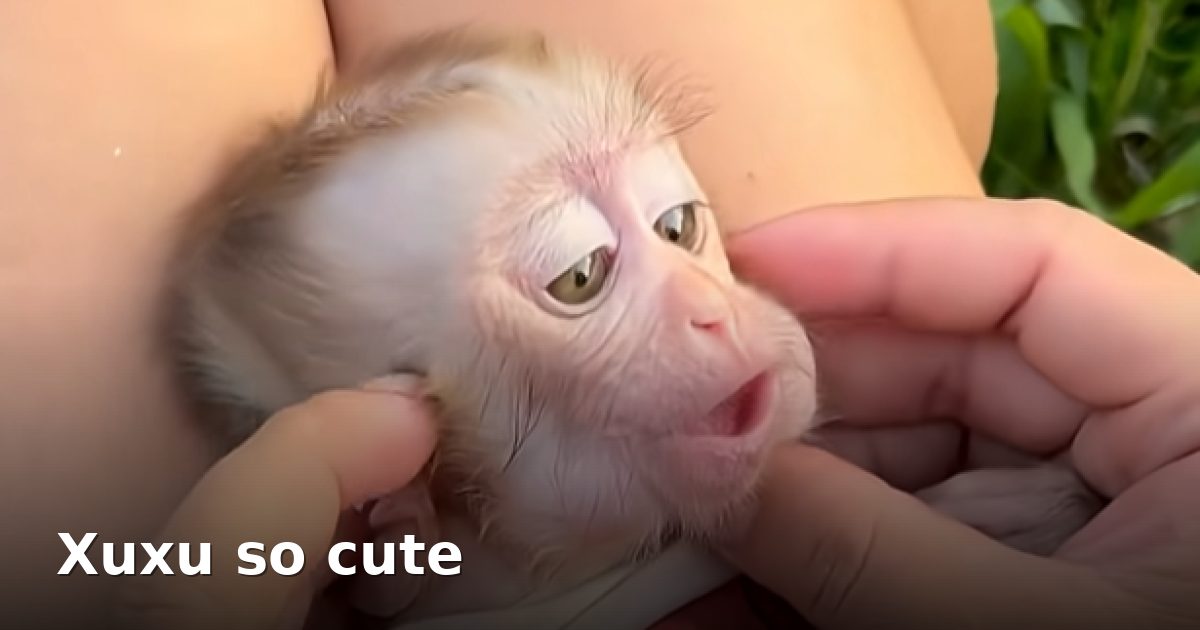
A baby monkey sits wrapped in a maroon, patterned outfit, wide-eyed, as a pair of human hands guides what looks like a small feeding device toward its mouth. Behind the pair, a stretch of green grass and a pair of bare human legs fill the frame. The video runs just a few seconds. It’s titled, simply, “Xuxu so cute 殺 #monkey.”
That’s the entire visible story in the footage posted to YouTube Shorts under a Vietnamese-language channel name. No caption explains who Xuxu is, where the clip was filmed, or why the monkey is dressed and being bottle- or dropper-fed by a human rather than a mother of its own species. Those blanks aren’t unusual for this corner of the internet — and they’re also why the clip is worth looking at more closely than its runtime suggests.
What the footage actually shows
Across the available frames, the scene barely changes. A small primate — young enough that its eyes dominate its face and its grip on a nearby finger looks reflexive rather than playful — is held upright against a seated adult’s lap. Human fingers press something resembling a pacifier or a soft-tipped feeding bulb against the animal’s mouth. The monkey’s arms are tucked inside a snug red garment decorated with a dark print, leaving only its hands, feet, and tail visible.
The setting looks informal and outdoors: grass, natural daylight, no studio lighting or visible enclosure. Nothing in the frames shows distress, restraint, or rough handling. The monkey appears calm, if alert, with its eyes tracking the camera or the hands in front of it.
That’s the limit of what can be confirmed. The channel listed with the video, “Thuyền Trưởng XSMB,” offers no public description or captions to explain the animal’s age, species, origin, or living situation, and none of that can be guessed from a few seconds of video.
A familiar online genre
Clips like this one — a young monkey dressed in baby clothes, fed by hand, filmed up close for an audience — belong to a video format that has become common across YouTube, Facebook, and TikTok over the past several years, largely originating from creators in Southeast Asia. Many of these channels present themselves as showing a beloved pet growing up. Some genuinely may be just that.
But the format has also drawn sustained scrutiny from wildlife researchers and animal welfare groups, who say the appeal of “cute” primate content has fueled demand that is harder on the animals than viewers realize.
An Associated Press report from Siem Reap, Cambodia, found that a baby monkey struggles and squirms as it tries to escape the man holding it by the neck over a concrete cistern, repeatedly dousing it with water, and that authorities say it is a growing problem as people look for new ways to draw online viewers to generate cash. The same reporting quoted Long Kosal, a spokesperson for APSARA, the Cambodian authority overseeing the Angkor site, saying the monkey should be living in the wild, where they are supposed to be living, but the monkey nowadays is being treated like a domestic pet.
Separately, the animal welfare groups Lady Freethinker and Action for Primates spent years investigating channels built around infant macaques. Their 2022 findings described how tiny infant macaques dressed in colorful, doll-like outfits sit fidgeting adorably in a row as their keeper puts rice cakes in front of them, while similar videos from other channels show clothed “pet” monkeys “dancing,spinning in circles and playing with toys as their seeminglyloving” owners talk to them softly, smile, or laugh. Investigators who visited some of the channel operators behind that content reported finding animals forced into cramped, barren wire cages with no access to food and water, and displaying stress-based behaviors once filming stopped.
A BBC World Service investigation, reported widely in the U.S. in 2025, went further, describing a global network of sadistic monkey torture after violent videos of people abusing and killing baby monkeys emerged on social media, some of it commissioned by viewers abroad and carried out by people in Southeast Asia. That extreme material is a different — and far darker — category of content than the clip discussed here. Nothing in Xuxu’s video resembles it. But researchers say the entire spectrum, from the gentlest “cute pet monkey” clip to the worst abuse footage, draws on the same underlying supply of infant monkeys pulled from the wild or bred in captivity for human entertainment.

Why the species matters
The young animal in the frames has the general build and coloring consistent with a macaque, the type of monkey most commonly featured in this genre across Vietnam, Cambodia, and Indonesia — though nothing in the clip confirms an exact species. That detail matters because of what’s happened to one macaque species in particular.
In 2022, the International Union for Conservation of Nature (IUCN) moved the long-tailed macaque from “Vulnerable” to “Endangered” on its Red List. The assessment behind that decision found the species had experienced “an inferred 50–70% decline over the past three generations (30 years) due to habitat loss and high levels of exploitation,” including demand driven by research, trade, and entertainment. A follow-up review tied specifically to the pet-and-content trade concluded that one of the key reasons for the species’ reclassification was intense hunting pressure and capture for the pet trade and entertainment.
In much of the region, that exploitation isn’t even clearly illegal. As one conservation commentator noted, in Indonesia both the long-tailed and pig-tailed macaque are not legally protected, and keeping them as pets chained up or caged, or bluntly killing them for being “pests,” is therefore not illegal.
What remains unknown
None of this background proves anything about Xuxu specifically. There’s no evidence in the available frames of mistreatment, and the channel’s broader content, location, and practices haven’t been reviewed here because no further material from it is publicly accessible. The monkey’s exact species, age, and how it came to be in a human household — whether bred, rescued, purchased, or taken from the wild — are not established by this clip and shouldn’t be assumed.
What can be said is that the clip fits a recognizable format that researchers, journalists, and wildlife officials have been examining closely for several years, precisely because “cute” footage and well-documented cruelty have been shown to come from the same pipeline of channels in more than one investigation.
Key takeaway
A single short video of a baby monkey being fed by hand can look like nothing more than a sweet moment. Taken on its own, that’s all this clip shows. But it sits inside a much larger, well-documented online trend involving young monkeys raised outside the wild for an audience — one that has pushed a once-common species toward endangered status and drawn the attention of conservation groups, journalists, and foreign law enforcement. Viewers deciding whether to watch, share, or support this kind of content may want to know that context exists, even when a particular video itself shows nothing alarming.
[“baby monkey video”, “long-tailed macaque”, wildlife documentary, “animal welfare”, youtube monkey videos, primate conservation, “endangered species”]
Wildlife
Summary of reporting
documentary
[“documentary”, “educational”, “seo”]
The material is a few silent video frames with no verified narrative, so an observational documentary approach paired with sourced background context lets readers understand both what is shown and the larger, well-reported trend it belongs to.
[Still frames show a baby monkey in a red patterned outfit being hand-fed by an adult outdoors on grass, posted as a YouTube Short titled ‘Xuxu so cute’ with no public caption or description, The IUCN reclassified the long-tailed macaque from Vulnerable to Endangered in 2022, citing exploitation including the pet and entertainment trade, Animal welfare investigators (Action for Primates, Lady Freethinker) documented cages and stress behaviors behind the scenes of similar ‘cute baby monkey’ channels in Cambodia, A BBC investigation reported a global network paying for monkey torture videos, a far more extreme category than the clip discussed, Associated Press reporting found Cambodian authorities investigating YouTubers for monkey abuse at the Angkor Wat site]
[The exact species of the monkey in the video, The monkey’s age, origin, or whether it was captive-bred, purchased, or taken from the wild, The identity, location, or broader practices of the channel ‘Thuyền Trưởng XSMB’, Whether any mistreatment of this specific animal occurred off camera, The meaning or significance of the name ‘Xuxu’ beyond its use as the monkey’s apparent name in the title]
A short, viral clip of a baby monkey named Xuxu being hand-fed looks adorable — but it belongs to an online genre that wildlife experts have been watching closely.
A Viral Baby Monkey Clip — and the Bigger Story Behind It
A few seconds of a baby monkey named Xuxu being hand-fed look sweet enough on their own. But clips like this belong to a wider online trend involving young monkeys raised for an audience — one that wildlife groups and the IUCN say has helped push a once-common species toward endangered status. Here’s the context worth knowing.
A young macaque-like monkey wrapped in a soft fabric outfit sits on a grassy lawn in natural daylight, being gently hand-fed by an unseen caretaker’s hands holding a small feeding device. Warm, soft outdoor lighting, shallow depth of field, documentary editorial mood, no text, no identifiable people, generic plausible setting.
A young monkey wrapped in fabric is hand-fed outdoors on grass in a still from a viral video.
A baby monkey in a patterned outfit is hand-fed outdoors in a still from the viral clip.
[How ‘pet monkey’ YouTube channels fuel the illegal primate trade in Southeast Asia, What the IUCN’s 2022 endangered listing means for long-tailed macaques, Inside the BBC’s investigation into online monkey torture rings, How U.S. viewers unknowingly support wildlife exploitation through viral animal clips]
[Cruelty for clicks: Cambodia is investigating YouTubers’ abuse of monkeys at the Angkor UNESCO site — https://www.ksat.com/news/world/2024/04/09/cruelty-for-clicks-cambodia-is-investigating-youtubers-abuse-of-monkeys-at-the-angkor-unesco-site/, New Investigation Exposes Horrifying, Hidden Cruelty to Baby Monkeys in ‘Cute’ Online Videos — https://ladyfreethinker.org/new-investigation-exposes-horrifying-hidden-cruelty-to-baby-monkeys-in-cute-online-videos/, “Caught on cam: Global investigation uncovers ‘sadistic monkey torture’ of baby macaques — https://cbsaustin.com/news/nation-world/investigation-uncovers-global-network-of-sadistic-monkey-torture-on-baby-long-tailed-macaques-wild-animals-youtube-videos-social-media-footage-action-for-primates-endangered-species”, IUCN Reaffirms Long-Tailed Macaques’ Endangered Status Despite Industry Pressure — https://awionline.org/news/iucn-reaffirms-long-tailed-macaques-endangered-status-despite-industry-pressure/, Removal from the wild endangers the once widespread long-tailed macaque — https://onlinelibrary.wiley.com/doi/full/10.1002/ajp.23547, Endangered species listing of long-tailed macaques: commentary — https://news.mongabay.com/2022/08/endangered-species-listing-of-long-tailed-macaques-shocking-painful-predictable-commentary/]
xuxu-so-cute-baby-monkey-video-context


2 Comments on “Xuxu So Cute”