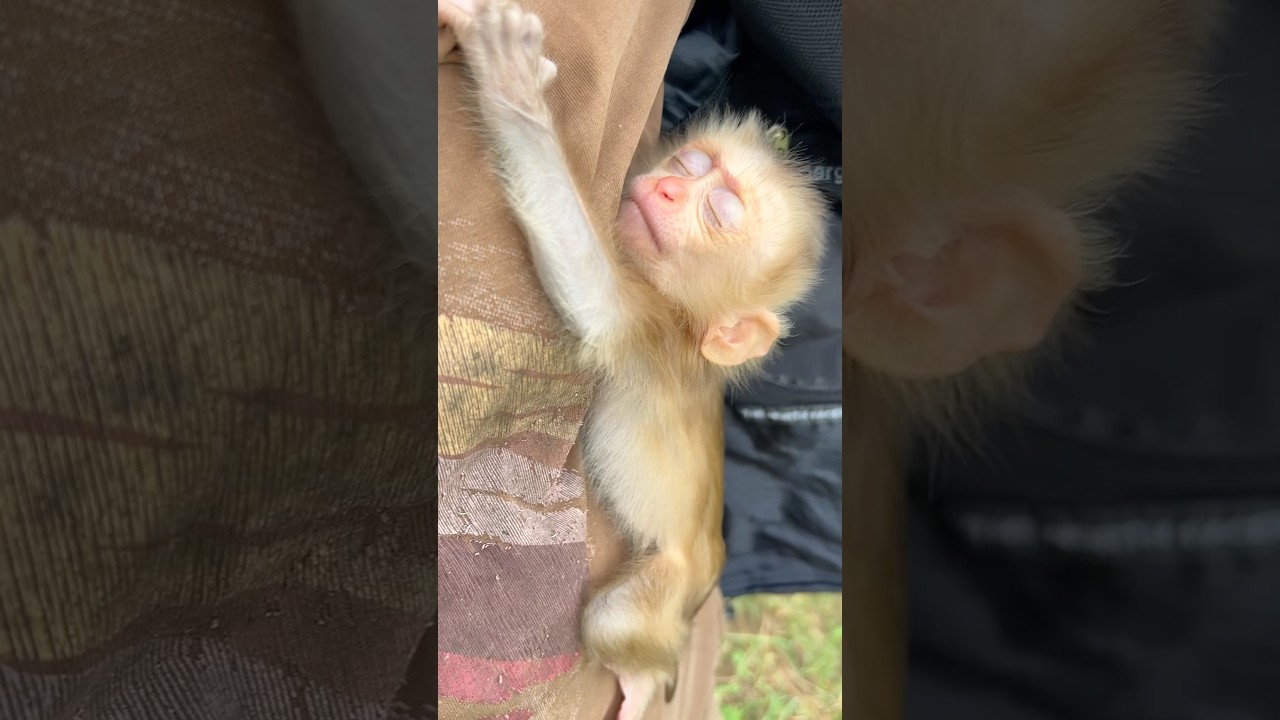
The infant’s eyes are closed, its fur still thin and pale gold against pink skin. One small hand is locked around a fold of fabric, fingers curled tight enough that the fist doesn’t move even as the rest of the body goes slack with sleep. There is no mother monkey in the frame. There is only a person’s shirt, and a baby holding on to it the way it would hold on to fur.
It is a strange and quietly moving thing to watch: an instinct built for the forest canopy, playing out on a piece of clothing in a village.
A Very Young Monkey, Far From a Troop
The video, posted to YouTube under the title “Xuxu was sleeping soundly in her mother’s shirt,” shows a single infant monkey, almost certainly a macaque based on its coloring, proportions, and the pink, still-developing face typical of newborns in the genus Macaca. The uploader’s title refers to a “mother’s shirt,” which appears to mean the clothing worn by a human caregiver rather than an animal mother — the fabric is patterned cloth, and a dark jacket with a visible zipper sits just behind it, with grass visible at the bottom of the frame.
No other monkeys appear in any of the four stills available from the clip. The infant is draped against the person’s side, head tucked down, eyes shut, one arm stretched upward with its hand gripping the shirt near the shoulder.
This is a village setting, not a forest or a zoo enclosure, and nothing in the available material confirms where this was filmed, who is holding the infant, or how the animal came to be there. Those details are simply not established by the footage, so they are not assumed here.
Holding On Without Thinking About It
What is visible across all four frames is consistent: the infant stays in the same position, asleep, with its hand maintaining a firm grip on the cloth. Like other primate infants, macaque infants are born with a grasping reflex and can cling using their limbs without any support from their mother. That reflex does not require the infant to be awake or alert to function. It is automatic, present from birth, and strong enough to support real weight.
In the wild, this grip is what keeps a newborn attached to its mother’s belly fur during travel, feeding, and rest. The infant’s ability to grasp onto a mother’s fur allows the mother to keep the infant with her while foraging or moving from one place to another, which benefits the mother because she does not lose use of her limbs or mouth, and gives the infant a degree of safety it would not have if left elsewhere. In this clip, the same reflex is being directed at a shirt instead of fur — the infant’s body doesn’t appear to distinguish between the two.
Veterinary descriptions of macaque development note that very little control is normally required from a macaque newborn, except for maintaining contact with its mother and orienting toward the nipple within the first one to two hours of life. Clasping and clinging are among the first functional behaviors a macaque infant has, well before it can walk, open its eyes fully, or respond to its surroundings in any complex way.
What the Footage Doesn’t Tell Us
It would be easy to read this scene as evidence of rescue, abandonment, or adoption — categories that come with real weight in wildlife reporting. None of them are supported here. There is no indication in the stills of an injury, no visible distress, and no confirmation of how long the infant has been with this person or why.
Infant macaques do sometimes end up in human care in places where troops live close to villages, often because a mother has died or because a very young animal becomes separated from its group. Rescue groups working with orphaned infant macaques have described cases where very young animals, sometimes only two to three weeks old, are taken in after losing maternal care and placed under dedicated caregiving. Whether anything like that applies here cannot be determined from a 30-second clip with no caption or field notes. The responsible thing is to describe only the clinging and the sleep, not to invent a backstory to match them.
It’s also worth noting that in the wild, this kind of abandonment is rare. In wild and free-ranging macaque groups, mothers do not typically abandon their infants, and researchers have instead documented mothers providing extra care for infants with disabilities or injuries that make normal clinging difficult. When human-raised infants do appear, it is more often tied to specific circumstances — illness, accident, or separation — than to ordinary maternal behavior.
A Reflex With a Long History
The grasp reflex seen here isn’t unique to macaques. Early clinging of this kind is sometimes called the palmar grasp reflex, and the strength of that grip is thought to reflect an evolutionary need to hold onto a mother’s fur while she moves through the forest canopy. Human infants show a faint version of the same reflex, though in a species that no longer carries its young through branches, it serves little practical purpose. In primates that do rely on it, the reflex also supports the development of more refined food-handling and manipulation skills later on.
Seen that way, the sleeping infant in this video isn’t performing anything unusual for its age. It is doing exactly what a macaque that age is built to do: hold tight to whatever is close, and let sleep take over regardless of what that “whatever” happens to be.
Key Takeaway
The footage shows one infant macaque, almost certainly only days to a few weeks old, asleep and gripping a person’s clothing with an instinctive reflex rather than a learned behavior. Nothing in the available material confirms the animal’s exact age, sex, species, location, or how it came to be in human care, and those gaps are left open rather than filled in with guesswork.
[“macaque”,”infant monkey”,”primate behavior”,”wildlife care”,”village wildlife”,”grasp reflex”,southeast asia wildlife]
Wildlife
documentary
Newborn Macaque’s Grip Reveals a Powerful Survival Instinct
A sleeping infant macaque clings to a person’s shirt — a look at the grasping reflex that keeps young primates alive in the wild.
newborn-macaque-grasp-reflex-clinging
This Sleeping Baby Monkey Won’t Let Go — Here’s Why
A days-old macaque sleeps soundly, one tiny hand locked onto a person’s shirt. It’s not learned behavior — it’s the same grasping reflex that lets wild infants cling to their mother’s fur from the moment they’re born, strong enough to hold on even in deep sleep.
A close-up editorial wildlife photo style image of a very young infant macaque with sparse pale-gold fur and a pink face, eyes closed in sleep, one small hand gripping a fold of fabric on a person’s clothing. Soft natural daylight, shallow depth of field, warm tones, outdoor village setting with a hint of green grass in the background. Gentle, intimate, calm mood.
A sleeping infant macaque grips a fold of fabric on a person’s shirt with one small hand.
A very young macaque sleeps while gripping a person’s shirt with its instinctive clinging reflex.
[The video shows a single infant monkey, appearing to be a very young macaque, asleep and gripping a person’s clothing.,No adult monkey appears in any of the four available still frames.,The uploader’s title refers to the animal sleeping in a ‘mother’s shirt,’ which based on the visuals refers to a human caregiver’s clothing.,Primate infants, including macaques, are born with a grasping reflex that allows them to cling to a caregiver without voluntary effort.,The location, exact age, sex, species, and circumstances of the infant’s care are not confirmed by the available material.]
[The exact species of the infant monkey (described generally as a macaque based on appearance),The exact age of the infant in days or weeks,The location where the video was filmed,The identity or role of the person holding the infant,Whether the infant was orphaned, rescued, or is otherwise in regular human care,Whether ‘Xuxu’ is the infant’s name]
[Xuxu was sleeping soundly in her mother’s shirt.#monkey — https://www.youtube.com/shorts/Ad9FsntHnWU,What I learned throughout behavioral observations on Japanese macaques — https://link.springer.com/article/10.1007/s10329-021-00892-z,Palmar grasp reflex — https://en.wikipedia.org/wiki/Palmar_grasp_reflex,Basics of Macaque Pediatrics — https://www.vetexotic.theclinics.com/article/S1094-9194(12)00013-8/pdf,Brachiation (palmar grasp reflex overview) — https://www.sciencedirect.com/topics/agricultural-and-biological-sciences/brachiation,Wild macaques don’t abandon babies. So why did Punch’s mother? — https://theconversation.com/wild-macaques-dont-abandon-babies-so-why-did-punchs-mother-277065,Hand-Rearing Baby Monkeys: Abu-Zoey’s Life At Wildlife SOS — https://news.wildlifesos.org/hand-rearing-baby-monkeys-abu-zoeys-life-at-wildlife-sos/]
[“documentary”,”educational”,”narrative”]
The material is a single short, caption-less clip of instinctive infant behavior, so a calm documentary voice paired with light scientific context lets readers understand the reflex without overstating what the footage shows.
[How orphaned infant macaques are hand-reared and eventually reintroduced to troops,The biology of the palmar grasp reflex across primate species, including humans,How villages across Southeast Asia coexist with resident macaque troops,What researchers have learned from rare cases of primate infant adoption in the wild]