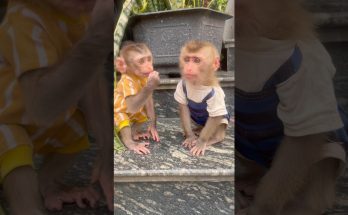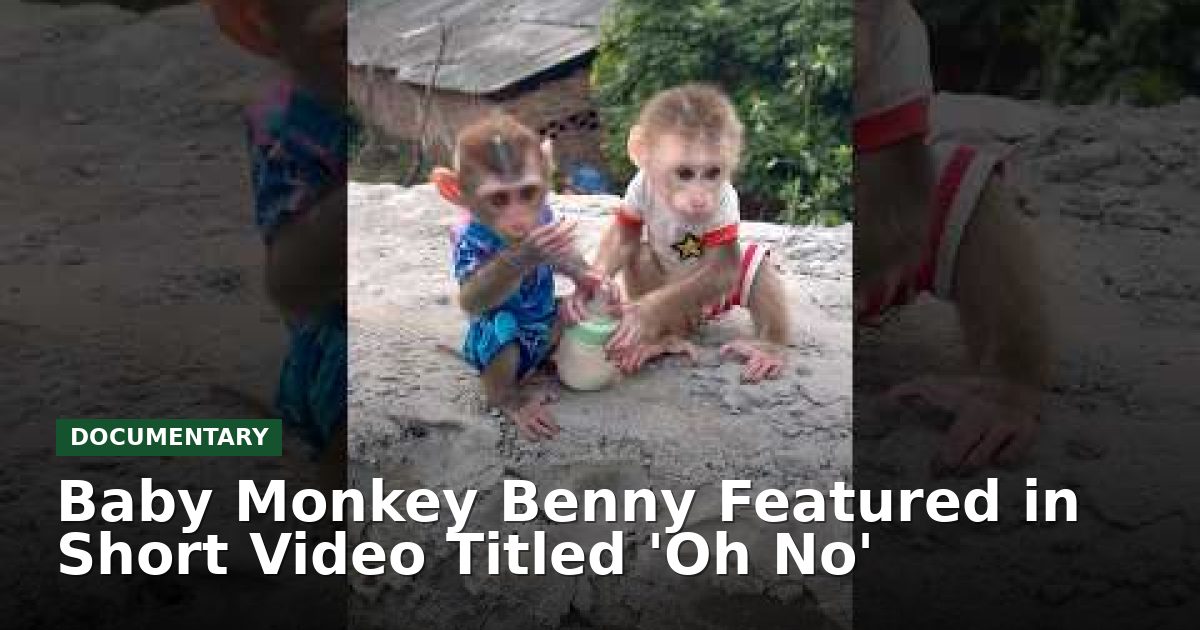
Two young monkeys sit side by side on a rough, weathered concrete ledge, a plastic baby bottle filled with a milky liquid propped between them. One wears a blue patterned outfit, the other a white shirt trimmed in red with a yellow star stitched across the chest. Behind them: a corrugated metal roof, a low brick structure, and a wall of green leaves swaying at the edge of the frame.
That is the scene captured in a YouTube Short titled “Oh no Monkey Benny,” posted to a channel built around a young monkey named Benny. The clip runs only a few seconds, carries no public description or captions, and offers little context beyond what the camera catches. But it belongs to a type of video that has quietly become one of the most watched — and most debated — categories on the platform.
What the Video Shows
Across the four moments captured on camera, the two young monkeys stay close together on the same concrete perch. In the earliest frame, one monkey has a pair of small sunglasses pushed up, while the other reaches toward the bottle resting between them. A few moments later, both animals lean in together, one gripping the bottle with both hands while the other watches closely. By the final frame, only one monkey remains in view, the bottle tipped up to its mouth as it appears to drink.
The setting does not change. It’s an outdoor, rural-looking location — a raw concrete slab, likely part of a wall or foundation, with a tin-roofed building and dense greenery in the background. There’s no studio, no obvious staging beyond the clothing the monkeys wear.
A Familiar Format on YouTube
The channel behind the clip describes its star in simple terms. Benny is described as a playful, adorable baby monkey with a big heart and a cheeky smile, with viewers invited to join him on his daily adventures as he plays, learns, cuddles, eats bananas, and explores the world around him. That framing — a named baby monkey with a running cast of daily-life clips — mirrors dozens of similar channels now active on YouTube and other platforms.
These channels typically post short, repetitive clips: a young monkey in child-sized clothing eating, drinking from a bottle, or sitting with another young animal. The format is simple, the clips are short, and the appeal is immediate — which helps explain why this style of content routinely pulls in large view counts.
The Behavior Behind the Clip
From the footage alone, the behavior on display is limited but observable. The two monkeys stay in close physical contact throughout, a pattern consistent with young primates that seek proximity to another animal for comfort. The bottle-drinking seen in the final frame is a human-introduced behavior — infant monkeys in the wild nurse directly from a mother rather than from a bottle — and its presence here indicates the animals are being hand-reared or supplementally fed by people rather than living with a troop in a natural setting.
Nothing in the stills indicates distress, nor does anything confirm the animals’ overall living conditions, how old they are, or whether the two are related. The video simply does not provide that information, and nothing should be assumed beyond what the frames actually show.
A Genre Under Scrutiny

Context matters here, because “baby monkey” content has drawn sustained attention from animal-welfare researchers in recent years — not necessarily this specific channel, but the broader category it belongs to. A coalition of animal-protection groups known as the Social Media Animal Cruelty Coalition conducted research into this online trend, which it says is inherently abusive and is being fueled by social media, recording 1,226 content links from Facebook, Instagram, TikTok and YouTube showing macaques kept as pets between September 2021 and March 2023.
That coalition’s findings focused specifically on young macaques used in this style of content. Videos showing macaques wearing nappies or baby clothes, being bottle-fed and bathed, and being cradled or kissed by their human “mum” or “dad” are among the most popular, with the macaques used for social media content often only a few days old, isolated from the large family groups that bring them comfort.
A separate investigation by the animal-advocacy group Lady Freethinker, working alongside Action for Primates, examined conditions behind several similar channels in Cambodia and sent an investigator to meet with several popular social media-channel owners, finding animals forced into cramped, barren wire cages with no access to food and water, and displaying stress-based behaviors once cameras were off. One of the investigators quoted in that report argued that “forcibly removing and depriving infant monkeys of their mothers and raising them in captivity in unnatural conditions is extremely cruel and will result in abnormal behavior and development and lead to severe psychological and physical problems.”
None of that research names or identifies the channel behind “Oh no Monkey Benny,” and there is no evidence tying this particular video to the specific abuses documented in those investigations. The point of including it is context: the format on display here — a young monkey in human clothing, bottle-fed on camera — is the same format that has prompted welfare groups to scrutinize the industry as a whole.
What Remains Unknown
Several basic facts about this video simply aren’t available. The exact species of the two monkeys can’t be confirmed from still images alone, though their coloring and features are consistent with young macaques, a type of monkey frequently featured in this genre of content. Where the video was filmed, who owns or cares for the animals, their precise ages, and how they’re treated when the camera isn’t rolling are all unconfirmed.
The video itself offers no narration, no on-screen text beyond its title, and no channel statement addressing these questions. Viewers are left with four seconds of visible behavior and a title — “Oh no” — that gives no indication of what, if anything, prompted it.
Key Takeaway
The clip is a small, ordinary-looking entry in a very large and fast-growing online category. What it shows — two young monkeys, dressed, sharing a bottle on a concrete ledge — is unremarkable on its surface. But that same format sits at the center of an ongoing debate among animal-welfare researchers about how infant monkeys are sourced, raised, and used for this kind of content, which is worth keeping in mind before sharing or subscribing to videos like it.