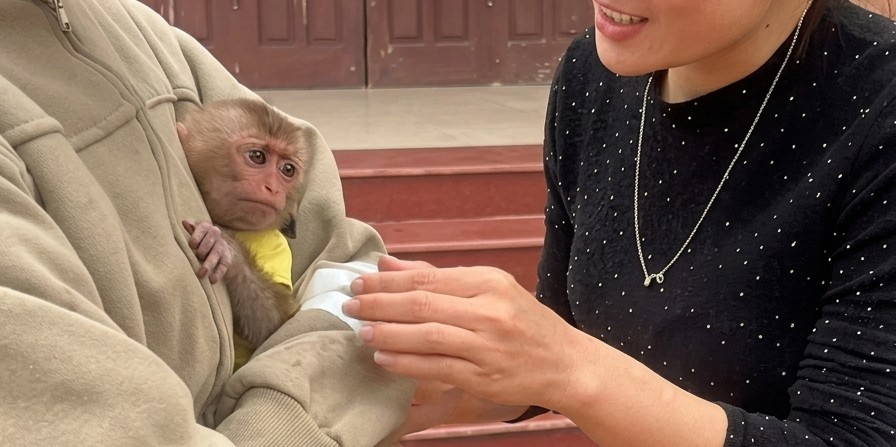
Few experiences evoke universal empathy quite like a toddler throwing a tearful tantrum when separated from a parent. In a viral YouTube Short titled “The little monkey didn’t want to go to school. He just wanted to stay home with his mother.🥲”—available at http://www.youtube.com/watch?v=ujf4ZU9r7lw—a nine-second clip of a tiny infant macaque mirrors human childhood distress with remarkable precision, amassing nearly twenty million views.
Breakdown of the Nine-Second Scene
Despite its brief length, the video presents a complete emotional arc of security, separation, and swift reunion:
- [00:00] – Safe in the Pouch: The video opens with a tiny monkey dressed in a yellow onesie, nestled snugly inside the zippered jacket of a caregiver wearing a beige hoodie and visor. The infant looks relaxed, cocooned by warm fabric.
- [00:02] – The Approach: A second woman dressed in black steps forward, smiling warmly and extending her hands to lift the monkey, speaking encouragingly to coax the infant out.
- [00:04] – The Panic Reaction: The moment the infant is lifted into the open air away from the jacket, panic erupts. The baby macaque thrashes its arms, kicks its legs, and screeches with its mouth wide open, frantically grasping backward toward the person in the hoodie.
- [00:06] – Instant Relief: Recognizing the animal’s distress, the woman promptly returns the infant to the beige jacket.
- [00:08] – Calm Restored: As soon as its body touches the warm interior of the jacket, the monkey instantly stops crying, burrows deep against the caregiver’s chest, and peeks out peacefully while receiving a gentle pat on the head.
Contact Comfort: Lessons from Evolutionary Biology
While the video’s title humorously frames the scene as a child refusing to go to school, the monkey’s desperate reaction is driven by deep-rooted survival biology.
In developmental psychology, the bond between an infant primate and its caregiver is defined by contact comfort—a concept famously demonstrated by psychologist Harry Harlow. Harlow showed that young primates prioritize tactile warmth and soft physical surfaces above almost all else, even choosing cloth surrogates over wire surrogates that provided food.
In wild troops, an infant macaque that loses physical contact with its mother faces immediate peril from falls, exposure, or predators. For the infant in the video, being lifted out of the hoodie at [00:04] mimics being separated from its mother’s body. The immediate screaming and flailing limbs are reflexive distress signals designed to alert the caregiver and demand an immediate retrieval.
Why the Internet Connects with Infant Primates
The immense popularity of the clip stems from the powerful psychological mechanism of anthropomorphism—our tendency to project human emotions and social scripts onto animals:
- Relatable Milestones: Every parent recognizes the flailing, tearful protest of a toddler being handed over at daycare or preschool drop-off.
- Visual Parallels: The yellow onesie, tiny gripping fingers, and expressive facial grimaces activate human caretaking instincts (Kindchenschema).
- Instant Resolution: The distress is fleeting; within seconds, the infant finds reassurance, offering viewers an emotionally satisfying sense of safety.
Ultimately, the short at http://www.youtube.com/watch?v=ujf4ZU9r7lw provides more than just a quick piece of social entertainment. It offers a window into the evolutionary wiring that connects human and non-human primates: an innate, non-negotiable need for physical warmth, security, and close maternal attachment.

One Comment on “Separation Anxiety in Miniature: The Science Behind a Baby Monkey’s Viral Meltdown”