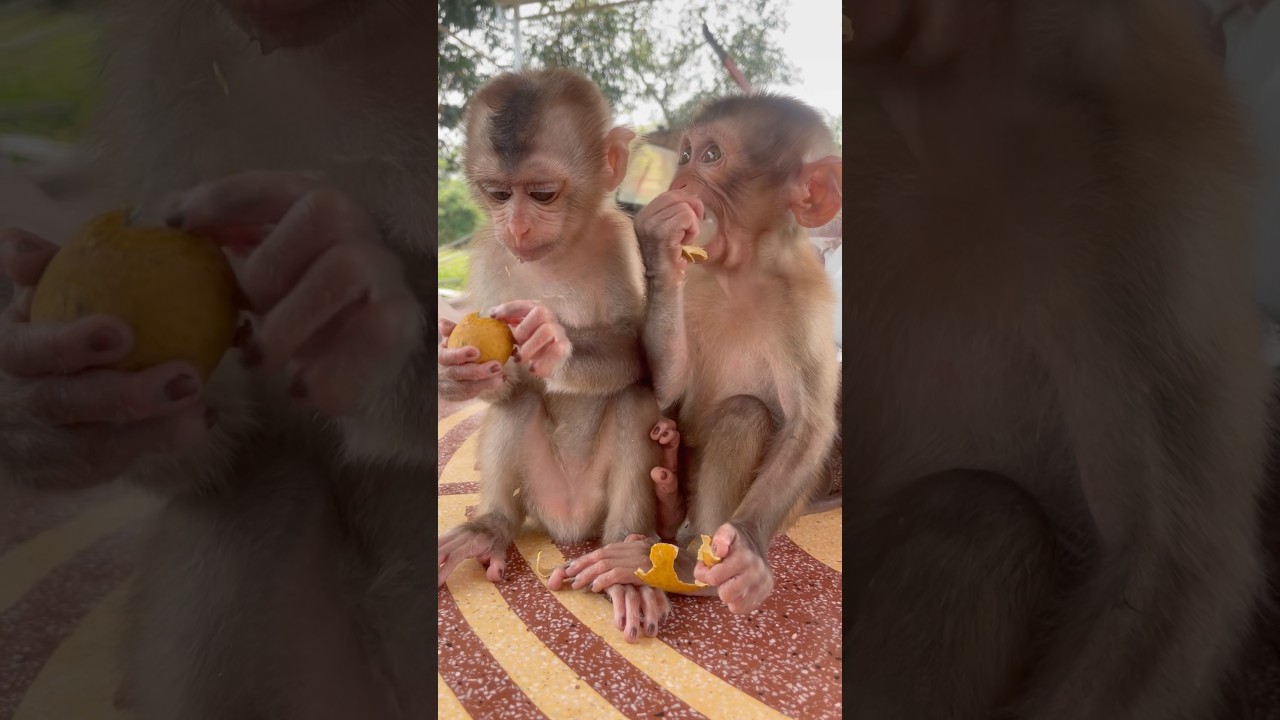
Two young monkeys sit side by side on a patterned tile floor, passing pieces of an orange back and forth while trees sway behind a corrugated roofline. That’s the scene in a short video posted by the YouTube channel Benny the Baby Monkey, titled simply “Monkey cute,” which went up on April 11, 2026.
There’s no narration, no on-screen text, and no description attached to the clip. What’s left is the footage itself: two small primates, close in size, working through a piece of fruit together while a human hand occasionally reaches into frame holding more fruit.
What the footage actually shows
Across the video, the two young monkeys stay close together, often touching shoulders or legs as they sit. One holds a whole piece of orange in both hands while the other peels and nibbles smaller pieces, occasionally popping bits into its mouth with quick, practiced movements. Peeled scraps collect on the tile between them.
In one frame, one of the monkeys reaches a long arm toward the camera, fingers extended, while the other stays focused on the fruit in its lap. Their body language throughout — relaxed shoulders, steady hands, unhurried eating — doesn’t show the stiffness, screeching, or pulling-away that typically signals fear or pain in young primates.
Based on the four stills available, there’s no visible indication of the animals being restrained, struck, or otherwise mishandled. That said, a few seconds of cropped video can’t speak to what happens before or after the clip, or where the animals live day to day.
Who or what is ‘Benny’
The channel describes Benny as a playful, adorable baby monkey with a big heart, inviting viewers to join him on daily adventures as he plays, eats, and explores. It promises new videos every week, covering feeding time and other life updates, and bills itself as family-friendly content for all ages. Beyond that self-description, there’s no independently published information confirming where Benny lives, who cares for him, or what country the videos are filmed in.
A much bigger online category
Videos like this one belong to a large and fast-growing corner of the internet sometimes called “monkey influencer” content — short clips of young macaques eating, playing, or being fed by hand, often posted to channels with cartoonish names and cute thumbnails.
Researchers who studied this category found it’s enormous. An analysis of content involving long-tailed macaques identified 1,366 instances across three major platforms: YouTube, Flickr, and Google. Of those, about 6% involved explicit abuse or discussion of abuse, with most of that tied to the pet trade rather than the entertainment trade, and the majority involving infant macaques.
That same research found something more specific to channels like this one. YouTube in particular tends to show macaques depicted as pets, especially as infants or juveniles, because viewers perceive them as more docile at that age. Researchers have cautioned that this kind of content can normalize human-macaque interactions tied to the pet trade in ways that may ultimately hurt the species’ conservation and welfare.
Animal welfare groups have raised a related concern about where these young animals come from in the first place. Many of the macaques used for this kind of social content are only a few days old when filming begins, separated from the family groups that would normally raise them, with some even recorded while their umbilical cords were still attached. Obtaining baby macaques from the wild often involves killing other members of their social group as hunters try to get past the adults protecting the infant.
None of that research names Benny the Baby Monkey specifically, and nothing in the available footage from this particular clip shows mistreatment. The point of the broader context isn’t to accuse this channel — it’s that viewers watching any “cute baby monkey” video are, whether they realize it or not, looking at a genre that wildlife researchers and welfare groups have been actively studying and raising questions about for several years.
The conservation angle most viewers never see
There’s also a species-level stake to this kind of content. The long-tailed macaque — among the primate species most commonly featured in this type of online video — has faced a reclassification fight at the international level, with concerns raised about its continued decline in the wild and the impact of international trade. It remains the most heavily traded non-human primate species and the one most widely used for research and toxicity testing. A species once considered common across Southeast Asia is now the subject of active debate over just how much trouble its wild populations are in.
What remains unclear
Several basic facts about this specific video simply aren’t available. The exact species of the two young monkeys hasn’t been confirmed. Their ages, their relationship to each other, where the footage was filmed, and whether the animals live as pets, in a sanctuary, or in some other arrangement are not stated anywhere in the channel’s public material.
What’s visible is limited to four still frames and a thirty-some-second clip: two young monkeys, an orange, a tiled patio, and a line of trees in the distance.
Key takeaway
The clip itself shows nothing alarming — two young monkeys calmly sharing fruit. But footage like this doesn’t exist in a vacuum. It sits inside a well-documented online category that researchers and wildlife groups have flagged for its ties to the exotic pet trade and its potential impact on a primate species whose wild population status is actively being reassessed.
[“baby monkey video”, “benny the baby monkey”, “macaque”, “wildlife documentary”, “animal welfare”, “youtube animal videos”, “long-tailed macaque”]
Wildlife
documentary
[“documentary”,”educational”,”seo”]
The material is a short, captionless animal video best served by careful observation of behavior paired with verified wider context, rather than invented narrative or drama.
[“A video titled “Monkey cute” was posted by the YouTube channel Benny the Baby Monkey on April 11, 2026″, “The channel’s own description presents Benny as a baby monkey featured in family-friendly daily-life videos”, “The available stills show two young monkeys sharing a piece of orange on a tiled patio with trees visible in the background”, “Researchers have documented that YouTube content featuring young macaques is a large and growing category, with a small but notable share tied to explicit abuse or the pet trade”, “Animal welfare organizations and researchers have raised conservation and welfare concerns about how infant macaques are sourced and used for this type of online content”, “The long-tailed macaque, among the most common species in such videos, has been the subject of international debate over its conservation status”]
[“The exact species of the two monkeys shown in the video”, “The ages of the two monkeys”, “The relationship between the two monkeys (siblings, unrelated, etc.)”, “The location where the video was filmed”, “Whether the monkeys are kept as pets, in a sanctuary, or in another arrangement”, “Whether the Benny the Baby Monkey channel itself has been the subject of any welfare complaints or investigations”]
A short video from the channel Benny the Baby Monkey shows two young monkeys sharing an orange — footage that sits inside a much larger, debated online genre.
Two young monkeys sit together on a tiled patio, sharing pieces of an orange.
Two Baby Monkeys, One Orange, and a Bigger Story Behind the Video
A short clip from the channel Benny the Baby Monkey shows two young monkeys calmly sharing an orange on a tiled patio. The footage itself looks harmless — but it belongs to a huge, closely watched online category that researchers and wildlife groups have been studying for years. Here’s what’s actually known, and what isn’t.
[“How researchers are tracking ‘monkey influencer’ content across social media”, “What happens to macaques once they age out of being ‘cute’ online pets”, “The difference between sanctuary wildlife footage and pet-trade content”, “Why long-tailed macaques are at the center of an international conservation debate”]
[“Benny the Baby Monkey — YouTube channel description”, “”Monkey influencers”: conservation culturomics of human-macaque interactions — ScienceDirect”, “Why you shouldn’t watch or share monkey videos online — World Animal Protection Australia”, “Action for Primates — 2025 news archive on long-tailed macaque trade concerns”]
A wide, naturally lit outdoor scene showing two young macaque-type monkeys sitting close together on a patterned tile patio, sharing a piece of citrus fruit, with leafy green trees and a simple open-air roof structure softly blurred in the background, candid editorial wildlife-documentary mood, no people, no text.
Two young monkeys sit together on a tiled patio sharing pieces of an orange outdoors.


One Comment on “Baby Monkey Video From ‘Benny the Baby Monkey’ Channel Surfaces Online”