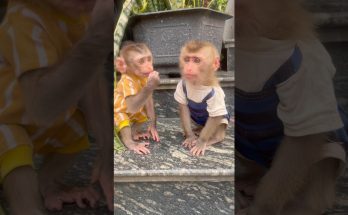
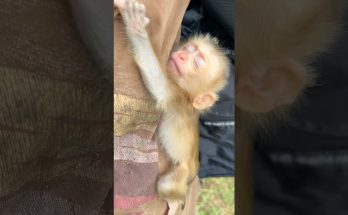
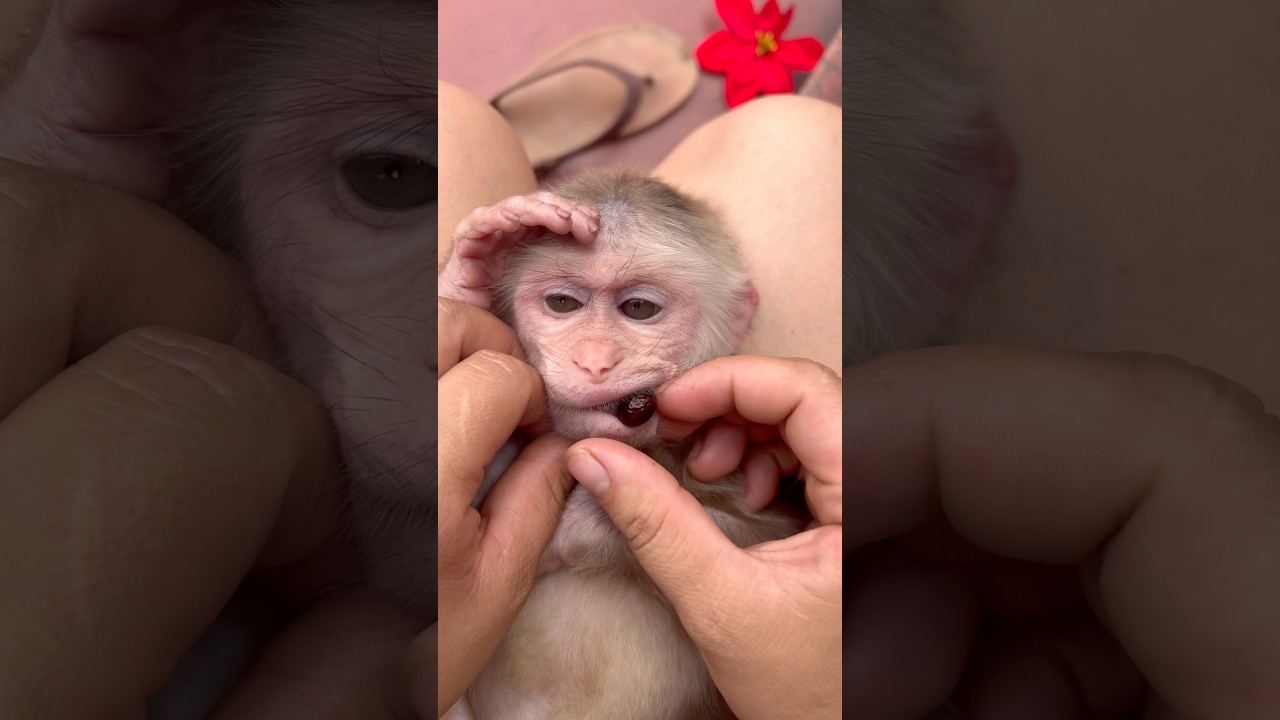
A small gray-furred monkey sits cradled in a pair of human hands, dark eyes fixed on the camera, as a fingertip gently smooths the fur on its forehead. A moment later, those same hands cup the infant’s chin while a small dark object — it looks like a berry or a piece of soft fruit — rests at the edge of its mouth. The scene is quiet, close-up, and framed against a pink blanket with a single red flower in the background.
That is the entirety of what can be confirmed from the still frames of a YouTube Short titled “Oh no ,” posted on March 29, 2026, by a channel called Benny the Baby Monkey. No video description, captions, or audio were publicly available to review, so the footage itself — and the emojis in its title — are the only clues to what viewers are meant to feel while watching it.
What the frames show
Across four captured moments — the opening frame, one early in the clip, one from the middle, and one later on — the composition barely changes. The baby monkey, which appears young based on its sparse, downy head fur and large dark eyes relative to its face, remains in the same position: held upright, facing the camera, supported by a human’s hands.
Its fur is pale gray on top with lighter, cream-colored fur below. A small dark item sits briefly near its mouth in the cover frame, consistent with hand-feeding. A flip-flop sandal and a plastic-looking red flower are visible in the blurred background, suggesting the footage was filmed indoors or on a porch, likely in a home setting rather than a sanctuary or clinical environment.
Beyond these physical details, nothing in the available material indicates where the monkey came from, who is holding it, what species it belongs to, or what happens in the rest of the clip that might explain the title’s sad-face emojis.
A familiar — and closely watched — genre
Videos like this one sit inside one of the most scrutinized corners of YouTube. Animal welfare investigators have spent several years documenting what they describe as a large, monetized ecosystem of “baby monkey” channels, many originating in Southeast Asia, built around infant macaques being bottle-fed, dressed, or filmed in close human contact.
A 2022 investigation by Lady Freethinker and Action for Primates sent an investigator to meet with several popular social media-channel owners in Cambodia, and what we learned was shocking — animals forced into cramped, barren wire cages with no access to food and water, and displaying stress-based behaviors.
The group’s co-founder has warned that “forcibly removing and depriving infant monkeys of their mothers and raising them in captivity in unnatural conditions is extremely cruel and will result in abnormal behavior and development and lead to severe psychological and physical problems.”
The scrutiny has not stayed online. A BBC World Service investigation into a monkey-torture ring tied to this broader content economy led to at least 20 people in the United States and two in Indonesia placed under investigation, including an Oregon man who was indicted in June 2023. Researchers tracking the category more broadly have found that 703 out of 5,480 videos examined by one coalition involved primates, and that “monkey hatred, especially focusing on baby monkeys, is a widespread problem that has been circulating for years on social media platforms.”
None of that documented pattern means the Benny the Baby Monkey channel is part of it. The channel’s own description, visible on its YouTube page, frames the content differently, describing a “playful, adorable baby monkey with a big heart and a cheeky smile,” inviting viewers to “join him on his daily adventures as he plays, learns, cuddles, eats bananas, and explores the world around him.” The page also bills itself as “family-friendly content perfect for all ages.”
What remains unclear
Nothing in the four available frames shows distress, injury, or mistreatment. The monkey’s posture is calm, its mouth open in what could be feeding or vocalizing, and the hands in frame appear to be supporting rather than restraining it. At the same time, the video’s own title — paired with three crying-face emojis — signals that something in the full clip struck its uploader, or is meant to strike viewers, as sad. Without the full video, audio, or a caption explaining that reaction, it’s not possible to say what prompted it.
It’s also not established from the available material what species of monkey is shown, its age in weeks or months, where it is being kept, or whether it is a wild-caught animal, a captive-bred pet, or part of a rescue situation.
Why it’s worth asking the question
Baby animal content is among the most-watched material on the internet, and infant monkeys in particular draw enormous audiences because of their human-like expressions and movements. That popularity is exactly why outside researchers keep returning to the category: it is lucrative, it is largely unregulated, and — as multiple independent investigations have shown — it has sheltered serious abuse alongside content that really is affectionate pet care. Viewers who enjoy these videos are increasingly being encouraged to ask a basic question before they watch, like, or share one: what do we actually know about how this animal is being kept once the camera stops rolling?