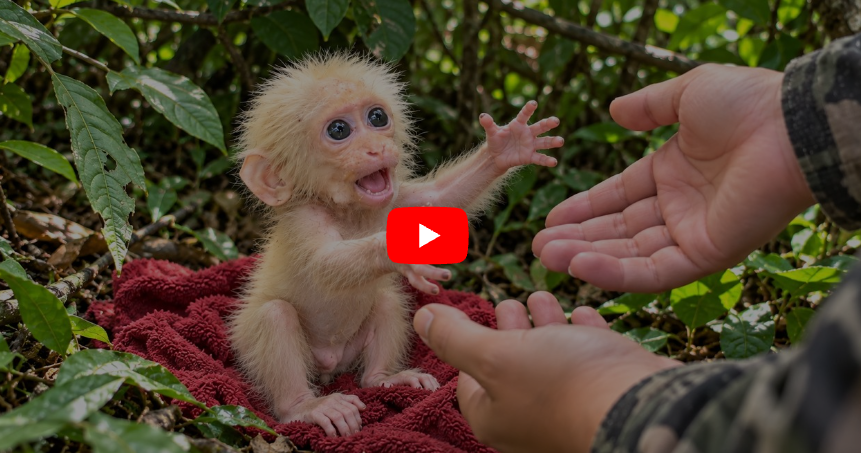
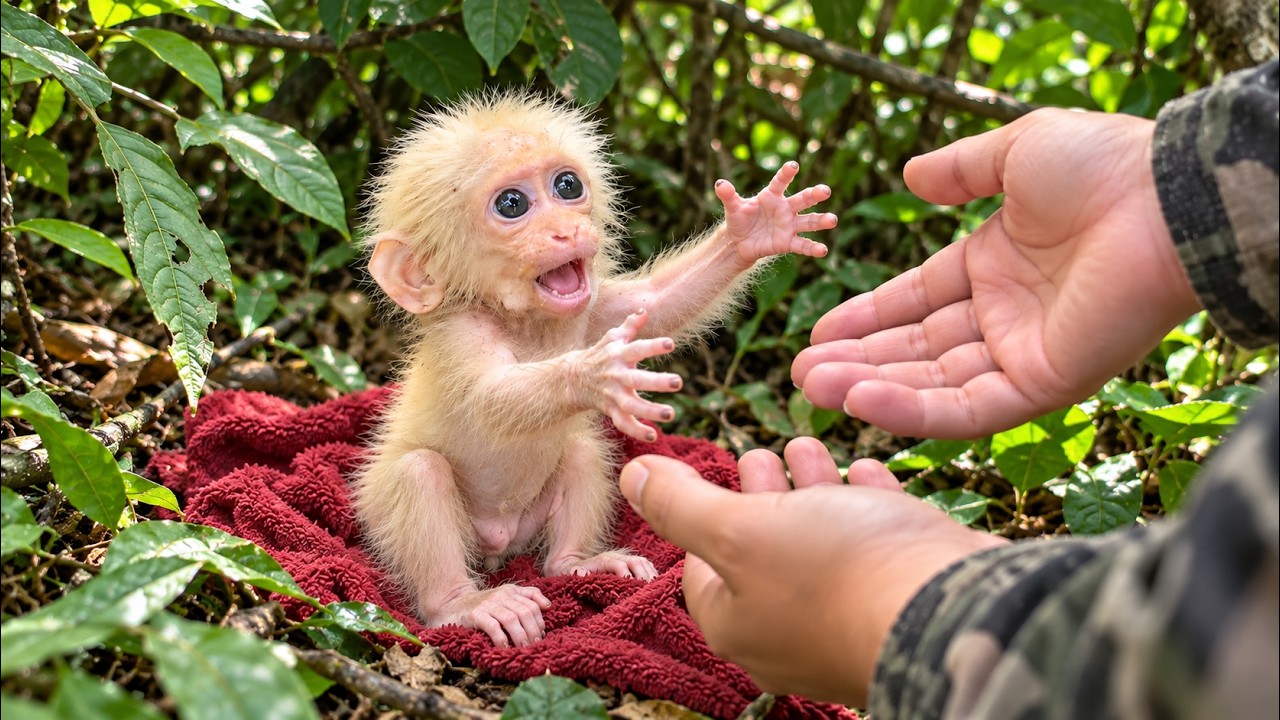
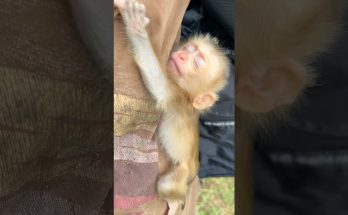
A tiny monkey with wispy, almost white fur sits on a dark red towel in the forest, both arms stretched toward a pair of human hands reaching back. Its mouth is open, its eyes wide. That single frame is the cover image for a video titled “Rescuing and Adopting a Poor ABANDONED Baby Monkey A Miraculous Journey!” posted to the YouTube channel known as Monkey Kabi — and it has become the kind of image that spreads fast across social media.
The video does not come with a public description or captions, so the only confirmed information comes from its title, its channel, and a handful of still frames pulled from the footage itself. Taken together, they offer a partial picture of what viewers are seeing — and raise real questions that the clip alone cannot answer.
What the footage actually shows
Early in the video, the infant monkey is held in a person’s arms against a backdrop of dense green leaves. Its fur is pale, almost blonde, and its skin appears light pink around the face. Its eyes are dark and notably large for its small head, a feature typical of very young primates.
Later, a pair of hands — one wearing a camouflage-patterned sleeve — holds the same animal while appearing to feed it a small piece of food wrapped in a broad green leaf. The monkey grips the food with both hands while a person steadies its head.
In a further scene, the monkey sits inside a woven basket lined with the same dark red cloth seen in the cover image, surrounded by ferns and a yellow flower. It appears calm, peering out from the basket with its hands resting on the fabric.
The cover frame — the one most likely to appear in search results and social feeds — shows the monkey sitting upright on the towel, arms raised toward a person’s open hands, mouth open as if vocalizing. It is a striking image, and it is almost certainly the moment the channel chose specifically because it is striking.
Who is behind the Monkey Kabi channel
Monkey Kabi describes itself as a real-life animal rescue and daily life channel that shares the everyday life journey of Kabi, a rescued monkey, and Dad, the human who cares for him, going through challenges, emotional moments, and unforgettable experiences every single day. The channel frames its videos as true stories about monkey rescue and recovery, daily care, survival, and bonding, showing baby monkey care and monkey survival stories as Kabi grows stronger day by day.
That self-description cannot be independently verified from the video alone. No information is publicly available confirming where the animal was found, what species it is, who is caring for it, or whether any wildlife authority or veterinary professional was involved. The pale coloring visible in the stills is also not something that can be explained from the footage — it may reflect a natural coat variation, lighting, or something else entirely, and no source available here confirms which.
A genre under growing scrutiny
<iframe width=”1430″ height=”804″ src=”https://www.youtube.com/embed/Do5wf-krx4Y” title=”Rescuing and Adopting a Poor ABANDONED Baby Monkey A Miraculous Journey!” frameborder=”0″ allow=”accelerometer; autoplay; clipboard-write; encrypted-media; gyroscope; picture-in-picture; web-share” referrerpolicy=”strict-origin-when-cross-origin” allowfullscreen></iframe>
Baby monkey “rescue” content has become one of the most-watched categories of animal video online, and it has also become one of the most closely examined by animal welfare researchers. The Social Media Animal Cruelty Coalition, a collaboration of animal protection organizations, investigated over 1,200 seemingly innocent videos showing macaques being bathed, dressed in clothes, or “rescued” and shared across platforms including Facebook, YouTube, and TikTok.
That research concluded that regardless of the level of cruelty displayed, keeping primates as pets is inherently cruel and compromises their welfare, so the report found that “pet” macaque videos — whether intentional or not — are profoundly harmful. Separately, Lady Freethinker and the World Animal Protection Society have found that many animal rescue videos online are staged, with the animals often not surviving the ordeal.
None of that research names the Monkey Kabi channel specifically, and nothing in the four stills reviewed here shows the animal in distress, nor does it show any act of cruelty. The point of this context is not to accuse a specific creator of wrongdoing without evidence — it is that viewers of this entire genre of video are increasingly encouraged to ask basic questions before sharing: Where was this filmed? Is the animal with a licensed sanctuary or wildlife rehabilitator? Does the same animal appear across dozens of videos, long past the age a wild-born infant would normally need hand-rearing?
Nina Jackel, founder of the U.S.-based nonprofit Lady Freethinker, has noted that one way to spot a questionable channel is that “you can often identify the same animals being used again and again.” Channels built around a single named animal, filmed day after day over months or years, are a recognized pattern in this space — one that can reflect either ongoing, legitimate care or repeated use of the same animal for content, depending on the circumstances, which an outside viewer typically cannot determine from the videos alone.
What remains unknown
Several basic facts about this particular video are not established by the material available: the exact location where it was filmed, the date of filming, the species and age of the animal, whether any veterinary or wildlife authority was consulted, and what happened to the animal after the scenes shown in the stills. The video’s title uses the word “abandoned,” but nothing in the footage reviewed independently confirms how the animal came to be separated from its mother or troop, if it was wild-born at all.
Key takeaway
The image of a wide-eyed baby monkey reaching for a human hand is emotionally powerful, and that is precisely why it travels so far online. But a single striking frame is not the same as a verified rescue story. Readers who come across this video, or others like it, can get more out of it — and protect themselves from being misled — by looking for the basic facts a caption alone often won’t provide: who is caring for the animal, under what authority, and what happens to it once the cameras stop rolling.

3 Comments on “Baby Monkey Rescue Video: What the Monkey Kabi Channel Shows”