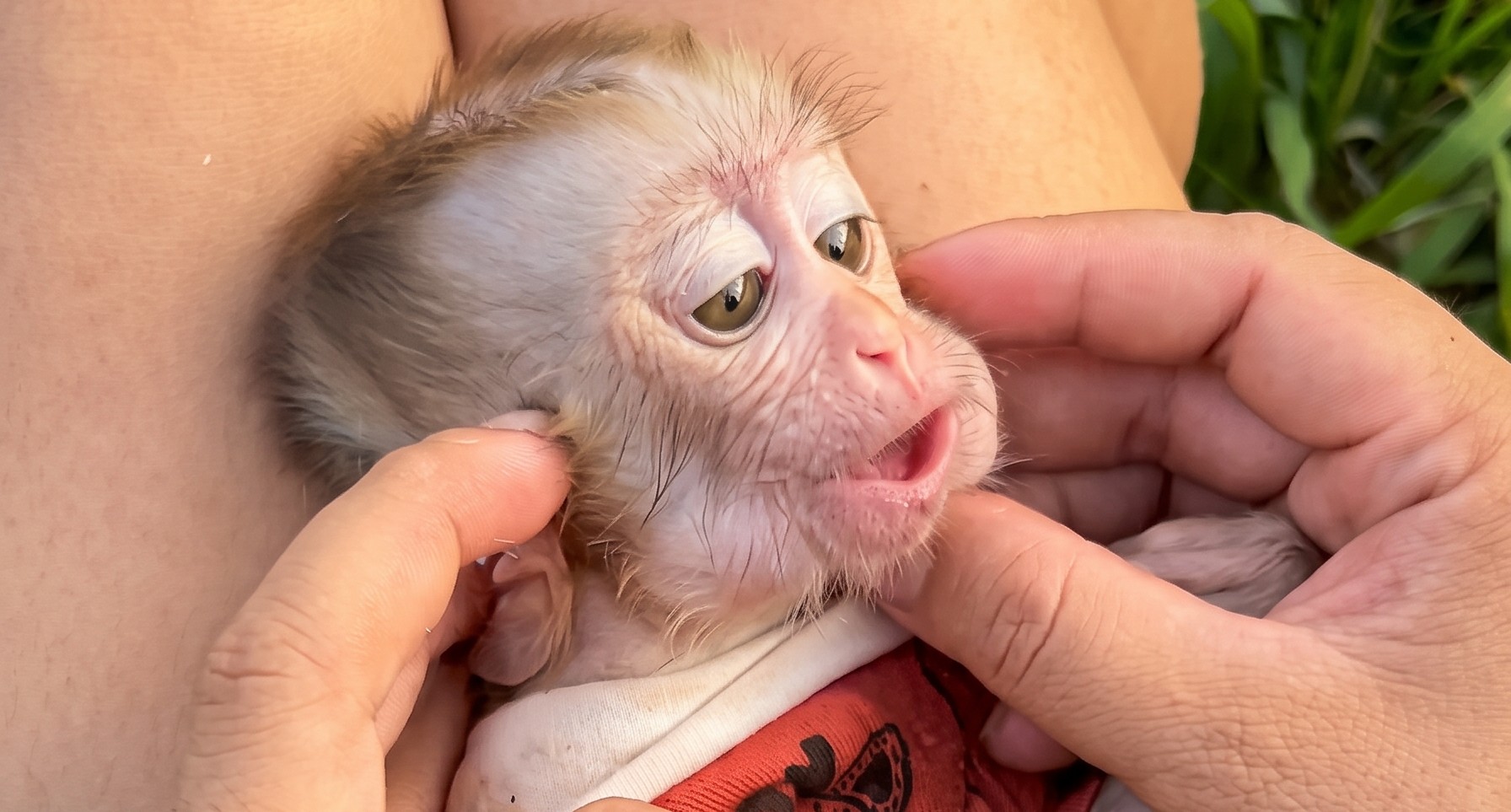
A short video making the rounds on social media shows a baby monkey, dressed in a small red patterned outfit, sitting on a person’s lap in a patch of grass. An adult’s hands hold the animal’s face steady while pressing what appears to be a pacifier or bottle nipple to its mouth. The infant’s eyes are wide open, its head fur a pale blond that will darken as it ages, its face still carrying the pink, un-pigmented look typical of very young macaques.
The clip is captioned simply “Xuxu so cute” with the hashtag #monkey. No description or transcript accompanies it, and the channel that posted it does not identify where or when the footage was filmed. Taken on its own, it’s the kind of thirty-second clip that earns a reflexive “aww” and a share.
But animal welfare researchers and journalists who have spent the past several years tracking this exact genre of content say that reflex is exactly the problem.
What the video actually shows
Four frames from the clip show the same basic scene repeated: a young monkey, likely only weeks or months old based on its size and coloring, held against an adult’s bare legs in an outdoor grassy area. Human hands — apparently belonging to the person filming or a second adult — manipulate the animal’s mouth and jaw throughout. The monkey wears a cloth outfit styled to resemble human infant clothing.
Nothing in the available frames shows visible injury, and nothing in them proves mistreatment. At the same time, the footage does not show where the animal came from, who is holding it, whether a veterinarian or wildlife authority has any involvement, or what happens to the monkey once the camera stops rolling. Those gaps matter, because they are exactly the questions that have driven a string of investigations into this type of content over the past few years.
A format with a documented pattern
Infant monkeys dressed in baby clothes, bottle- or pacifier-fed on camera, and filmed in staged domestic settings have become a recognizable production format online. A 2025 investigation into Vietnam-based “content farms” found that such channels upload multiple videos daily featuring infant macaques trained to perform human-like behaviors on camera, often under duress, including wearing baby clothes, eating junk food, interacting with toys or small animals like ducklings, and walking bipedally as a child would. The same reporting noted that scenarios are often recycled with slight variations to maximize content output.
The animal welfare group World Animal Protection has raised a related concern about where these infant monkeys come from in the first place. According to the group, obtaining baby macaque monkeys from the wild often involves killing other members of their social group as they try to protect the target animal from harm, a practice the group says is particularly concerning given their endangered status.
In some of the most serious cases, the pattern has escalated well beyond staged “cute” content. A year-long BBC World Service investigation reported that Indonesians are paid by hundreds of customers from the U.S., UK, and other parts of the world to torture and kill baby long-tailed macaques for custom videos. That investigation is a separate and far more extreme category of abuse than anything shown in this particular clip — there is no indication in the frames reviewed here that this video belongs to that category — but researchers say it illustrates how an audience built on “adorable baby monkey” content can be redirected toward darker material once a channel has viewers hooked.
Why the species matters
Based on its coloring and features, the infant in the clip appears consistent with a long-tailed macaque (Macaca fascicularis), also known as the crab-eating macaque — the species most commonly featured in this genre of baby-monkey content across Southeast Asia. That identification cannot be confirmed from stills alone, but it matters because of the species’ current conservation status.

The long-tailed macaque was once considered one of the most common primates in Asia. That changed in 2022, when the International Union for Conservation of Nature elevated the species’ status from ‘Vulnerable’ to ‘Endangered’ on the IUCN Red List of Threatened Species. A fresh scientific review completed in October 2025 reaffirmed that listing after a biomedical industry group petitioned to have it reversed; the updated assessment found that wild populations of the macaque had declined by 50-70% over the past three decades. Researchers point to declining native habitats, overutilization for scientific, commercial, and recreational purposes, inadequate regulatory mechanisms, and culling due to human-macaque conflicts as the combined drivers of that decline.
Put simply: a species that used to be considered a nuisance animal across much of Southeast Asia is now formally recognized as at risk of disappearing from parts of its range — and the pet and content trade is one of the pressures conservationists cite as part of the problem.
What can and can’t be confirmed about this clip
It is not possible, from the four frames supplied, to establish the location of the filming, the identity of the people in it, the specific channel’s broader catalog of videos, the animal’s current condition, or whether the monkey was born in captivity, rescued, or taken from the wild. The channel name itself gives no obvious connection to wildlife or primates, which researchers who track this content say is itself a common pattern — many of these accounts are run as general-purpose “content farm” channels rather than dedicated animal pages.
What can be said is that the video fits a widely documented visual template: an infant macaque, dressed in human-style clothing, restrained by hand, and bottle- or pacifier-fed in an outdoor domestic setting for the camera. That template has drawn sustained attention from primatologists, conservation groups, and investigative journalists specifically because of how often it has been linked — in other, separately documented cases — to wild capture, poor welfare, and in the most extreme instances, deliberate cruelty for paying audiences.
Key takeaway
A single cute clip doesn’t prove wrongdoing, and nothing here establishes that this particular animal was mistreated. But the broader genre it belongs to has been the subject of real investigations, real conservation warnings, and a real, confirmed decline in the wild population of the species involved. Viewers deciding whether to watch, like, or share this kind of footage are, in effect, deciding whether to add momentum to a specific, well-documented corner of the internet — one that researchers say has sometimes moved from staged cuteness toward genuine harm once it built an audience.
What remains unknown
The channel has not published any statement about the animal’s origin, housing, or care, and no independent organization is known to have reviewed this specific footage. Readers who want to support legitimate primate welfare work can look for content from accredited sanctuaries and conservation organizations, which typically disclose an animal’s rescue history, living conditions, and release or long-term care plans — information this clip does not provide.

One Comment on “A ‘Cute’ Baby Monkey Clip Is Racking Up Views — Here’s the Larger Story Behind It”