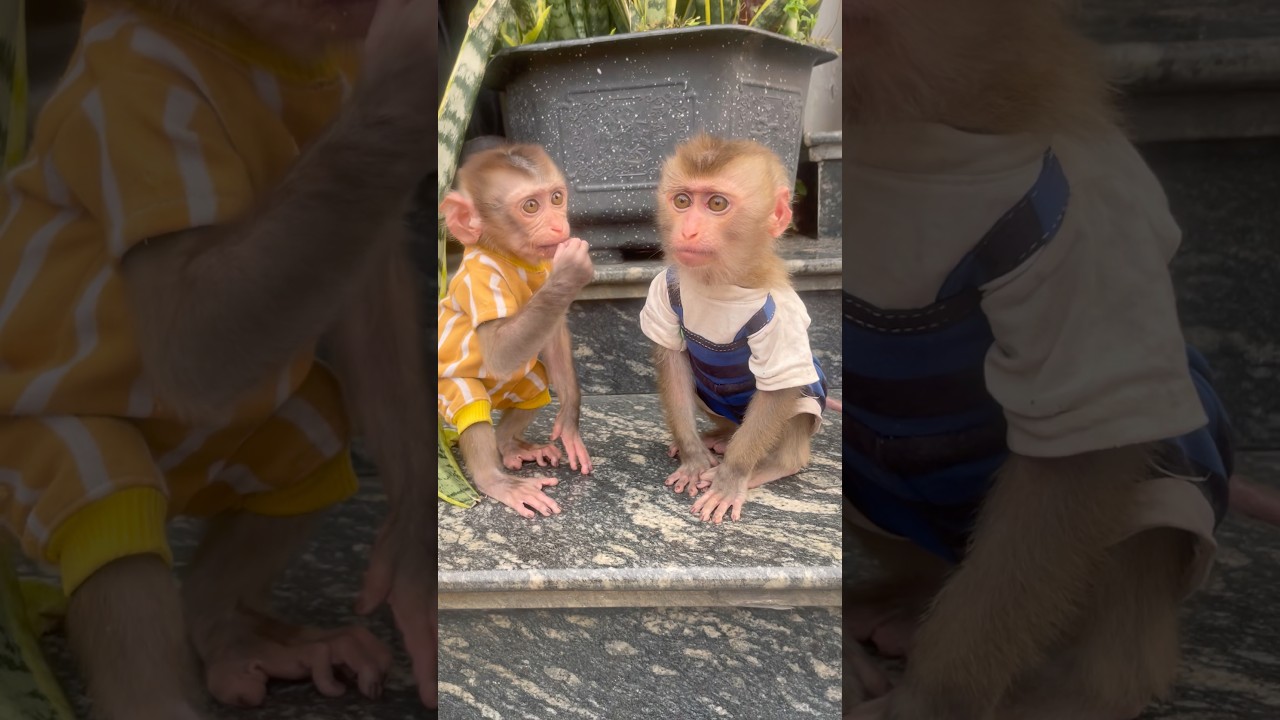
Two young monkeys sit side by side on a flight of stone steps. One wears a yellow-and-white striped top. The other is dressed in blue overalls over a white shirt. Behind them, a black plastic tub holds a potted snake plant, its long leaves framing the scene like a backdrop in a family photo.
It is an image built for a smartphone screen — small, soft-faced animals in children’s clothing, sitting still long enough for a camera to catch them. It is also, according to several international animal welfare investigations, a familiar shape. Monkeys dressed as toddlers have become one of the most common and most scrutinized categories of animal content on the internet.
What the Footage Actually Shows
The video comes from a YouTube channel called Benny the Baby Monkey, which describes itself as following a playful, adorable baby monkey with a big heart and a cheeky smile, joining him on his daily adventures as he plays, learns, cuddles, eats bananas, and explores the world around him. No caption or description accompanied this particular clip, so only the visible footage can be described here.
Across the available frames, two young monkeys — their pale, blond-tinged fur and large, round eyes suggest they are infant macaques, a group of monkeys widespread across Asia — move on all fours across a tiled or marble stair landing outside what appears to be a home or village building. Both wear fitted children’s clothing. One appears to bring a hand toward its mouth. Neither animal shows visible injury or obvious distress in the stills reviewed for this article. There is no narration or on-screen text to explain who is filming, where, or why.
That ordinariness is exactly what makes this category of video worth examining more closely.
A Pattern Investigators Have Been Tracking for Years
Clips of baby monkeys in clothing are not a fringe curiosity online. A coalition of animal protection groups called the Social Media Animal Cruelty Coalition, which includes World Animal Protection, investigated over 1,200 seemingly innocent videos showing macaques being bathed, dressed, or presented as rescued animals across Facebook, YouTube, and TikTok. The coalition’s conclusion was blunt: regardless of how a video is framed, experts agree that keeping primates as pets is inherently cruel, and the report concludes that such “pet” macaque videos are profoundly harmful.
The appeal of these videos, researchers argue, comes from treating monkeys like human infants. Baby macaques are seen as ideal subjects for “cutecontent where they are treated like human babies — videos showing them wearing diapers or baby clothes, being bottle-fed and bathed, and being cradled or kissed by a humanmom” or “dad” are among the most popular.
Separate field investigations have gone further. Lady Freethinker and the group Action for Primates sent an investigator to meet social media creators in Cambodia and found animals forced into cramped, barren wire cages with no access to food and water, and displaying stress-based behaviors. That same investigation documented some channels going further still, with videos showing cruelty outright, including deplorable methods of “discipline” such as hitting, biting, or hanging macaques upside down.
A separate BBC investigation traced an even darker extreme of the same genre, reporting that viewers who started out watching ordinary animal content found that YouTube’s recommendations gradually moved from monkeys dressed up in baby clothes toward videos of monkeys being slapped, and eventually monkeys being killed on-screen. That case involved a criminal network far removed from the clip described here — but researchers point to dressed-up “baby” monkey content as the common entry point of the pipeline, not the end point.
Reporting from Southeast Asia has documented the production side of this industry directly. One investigation into content farms in Vietnam found that channels upload multiple videos daily featuring infant macaques trained to perform human-like behaviors on camera, often under duress, including wearing baby clothes, eating junk food, interacting with toys, and walking upright as a child would.
Why Clothing on a Wild Animal Is a Signal, Not Decoration
Macaques are not naturally dependent on human caregivers the way the videos often suggest. In the wild, baby macaques typically stay close to their mothers for a year or longer, a bond essential to their mental and emotional wellbeing given that these animals live their entire lives in large, multigenerational family groups. An infant macaque that can be dressed, posed, and handled calmly on steps for a camera is, by definition, an animal that has been separated from that normal developmental path and habituated to close human handling — something that does not happen naturally in a forest troop.
None of this means the specific animals in this video are being mistreated off-camera. The footage available does not show cages, restraints, or any physical harm, and nothing here should be read as an accusation against this particular channel. What can be said is narrower: this video belongs to a recognizable format that welfare investigators have repeatedly found, upon closer inspection, to involve animals removed from normal social and physical conditions, and sometimes far worse.
What Responsible Viewers Can Take From This
It is difficult to know from two baby monkeys sitting quietly in borrowed clothing what their daily life actually looks like once the camera is off. That uncertainty is itself the point. Cuteness is not evidence of welfare, and a calm, photogenic moment does not rule out conditions that would trouble most viewers if they could see them.
Wildlife biologists and conservation groups increasingly urge the public to judge these videos by the biology, not the costume. A macaque’s childhood, left undisturbed, is spent clinging to its mother’s fur, riding on her back through the trees, and slowly learning to forage alongside a troop — not sitting upright on tiled steps in a striped shirt. The more that kind of ordinary wild behavior gets replaced on camera by human mimicry, the harder it becomes to tell whether an animal is thriving or simply performing.

3 Comments on “Two Baby Monkeys in Matching Outfits: What the Camera Doesn’t Show”