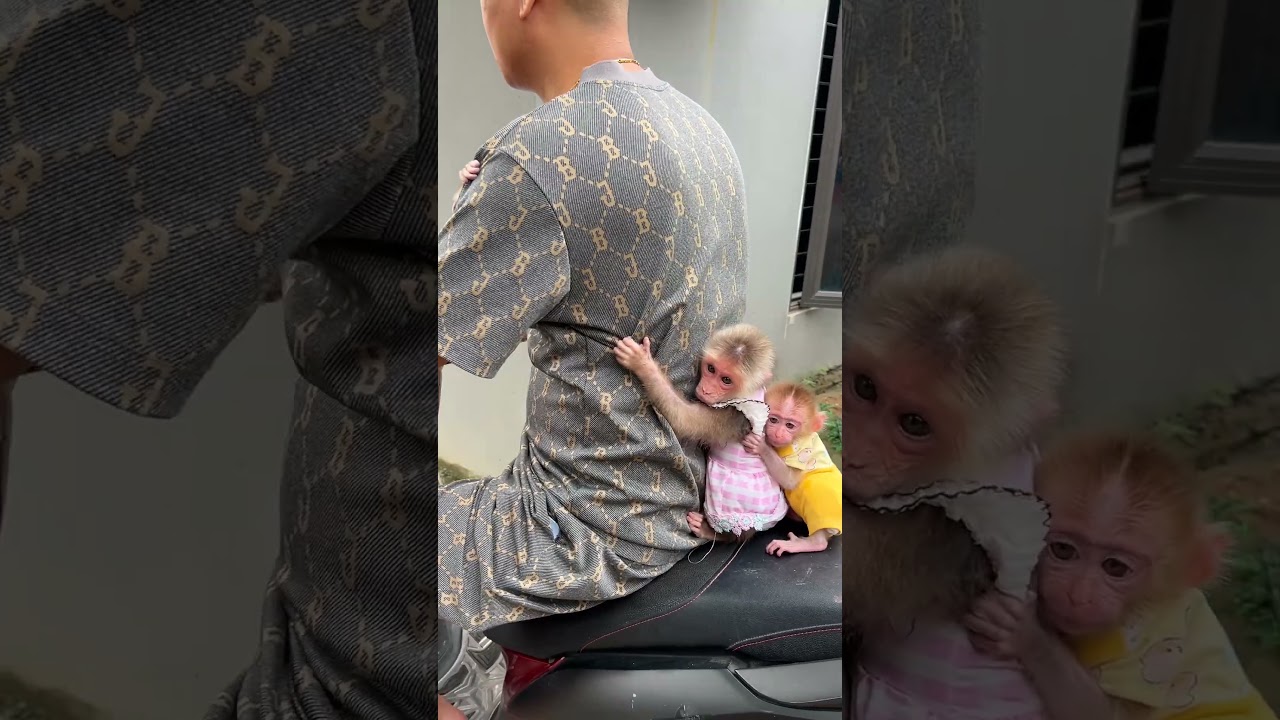
A man in a patterned gray shirt sits on the seat of a parked motorbike outside a house. Beside him are two young monkeys, dressed not in anything resembling natural fur-baring infancy but in children’s clothes — one in a pink gingham dress trimmed with lace, the other in a yellow top. One monkey reaches up and grips the back of the man’s shirt with its hand. Neither animal is doing anything a wild infant macaque would normally do in its first months of life.
The clip, posted to YouTube under the title “Dad took the baby monkey for a walk,” has circulated as a short-form video. The uploader’s own label calls the man “Dad,” but that is the creator’s chosen framing, not a confirmed family relationship — macaques are wild animals, and no evidence in the footage establishes who this man is to the two young primates beside him.
What the Still Frames Show
Across four frames taken from the video, the scene barely changes. The man remains seated on the motorbike, his back to the camera for most of the sequence. The two young monkeys stay close to him and to each other, their outfits unmistakably made for human infants rather than cut down for an animal’s body. In the clearest frame, one monkey has both hands wrapped around the fabric of the man’s shirt at his lower back, the posture of an infant primate clinging to something solid rather than one playing or exploring.
Behind them is a plain wall and a barred window, suggesting a home or small building rather than a forest, sanctuary, or managed wildlife park. Nothing in the frames shows a leash, cage, or visible restraint, but nothing shows open ground, trees, or any other monkeys from a wider troop either.
A Pattern Animal Welfare Investigators Have Already Documented
Videos of young monkeys dressed in baby clothes, fed by hand, and treated like human infants have become a recognizable genre online, and several animal protection organizations have investigated it at scale. The Social Media Animal Cruelty Coalition, a coalition that includes World Animal Protection, investigated over 1,200 seemingly innocent videos showing exactly this kind of content. These showed macaques being bathed, dressed in clothes, or ‘rescued’ and were shared across multiple social media platforms, including Facebook, YouTube, and TikTok.
The same coalition’s broader review found the problem is not limited to a handful of bad actors. The report documented over 2,800 incidents of monkey abuse and cruelty, ranging from the subtle and possibly unintentional to the deliberate and obvious, with over 60% of the links analyzed containing overt physical abuse to these pet macaques, another 13% including deliberate psychological torture, and 12% physical abuse amounting to torture.
A separate investigation into Vietnam-based “content farms” described the specific visual formula on display in clips like this one: wearing baby clothes, eating junk food, interacting with toys or small animals like ducklings, and walking bipedally as a child would, produced as part of channels where infant macaques are trained to perform human-like behaviours on camera, often under duress.
None of this means the specific man and two monkeys in these frames have been tied to abuse — nothing in the available footage shows mistreatment, and this article does not claim otherwise. But the visual template is unmistakably the same one welfare groups have flagged repeatedly: infant monkeys, human baby clothing, and a human handler presenting the pairing as heartwarming family content.
Why the Framing Itself Is a Welfare Concern
Separate from any question of outright cruelty, researchers point out that the basic premise of this content — infant monkeys dressed and handled like human babies — conflicts with how young macaques actually develop. Baby macaque monkeys are also seen as perfect victims for creating ‘cute’ monkey videos where they are treated like human babies, even though in the wild these animals form long-term bonds with their mothers that are essential for their mental and emotional well-being, particularly considering macaques live their whole lives in large, multigenerational family groups.
Investigators who have traced the supply chain behind this content note that the animals used are frequently separated from their mothers at an extremely young age. The macaques used for social media content are often only a few days old, isolated from the large family groups that bring them comfort, and in some cases the monkeys were recorded with their umbilical cords still attached. A co-founder of the advocacy group Action for Primates has argued that forcibly removing and depriving infant monkeys of their mothers and raising them in captivity in unnatural conditions is extremely cruel and will result in abnormal behavior and development and lead to severe psychological and physical problems.
Reporting on the broader phenomenon in Cambodia described a similar dynamic playing out in public, where wild macaques living near a UNESCO heritage site have become used to handouts and close human contact, with an APSARA site official noting plainly that the monkey should be living in the wild, where they are supposed to be living, but the monkey nowadays is being treated like a domestic pet.
What Can and Cannot Be Concluded From This Clip
From the frames alone, it is possible to say only this: two young monkeys, dressed in children’s clothing, were filmed beside a man seated on a motorbike outside a residential-looking building, and at least one of the monkeys repeatedly gripped the man’s shirt. Their species cannot be confirmed with certainty from stills, though the body type and coloring are consistent with juvenile long-tailed macaques, the species most frequently used in this category of online content according to multiple animal welfare investigations.
What cannot be established from the footage is where the video was filmed, how the animals came to be with this person, whether they were legally obtained, what their living conditions are when the camera is off, or whether any of the specific abuses documented in wider industry investigations apply here. No claim of mistreatment is made about this individual video; the surrounding context is offered because the visual format is one that has drawn sustained scrutiny from researchers and journalists.
Wildlife Context: How Infant Macaques Actually Grow Up
In the wild, infant macaques spend their first year or more in almost constant physical contact with their mothers, who carry them, nurse them, and allow them to explore only gradually as confidence and coordination develop. Troops typically include multiple generations, and young macaques learn foraging routes, social rules, and danger signals by watching older animals rather than by being dressed and posed for an audience. None of that developmental process is visible in a clip built around a stationary motorbike seat and matching outfits — which is precisely the gap welfare researchers say viewers should notice.
A Reasonable Way to Watch This Kind of Content
Viewers encountering monkeys dressed as children online are not wrong to find the image striking. But striking is not the same as harmless. Given how well documented the wider pattern has become, the most responsible response to a clip like this one is simple curiosity about its origins rather than uncritical sharing — and recognizing that a wild monkey in clothing, on a motorbike seat, far from any forest or troop, is not evidence of a happy pet. It is evidence of a question still worth asking.

One Comment on “Baby Monkeys in Matching Outfits Cling to a Motorbike Rider: What the Clip Actually Shows”