For young primates, learning how to eat solid food is a gradual trial-and-error process that often requires a watchful parent. In a popular nine-second YouTube Short titled “Benny the monkey has something stuck in his mouth.”—shared on the channel Benny the Baby Monkey at http://www.youtube.com/watch?v=p_rJkvnKe5M—viewers are given an up-close look at an everyday parenting challenge: helping an overambitious baby dislodge a mouthful of food.
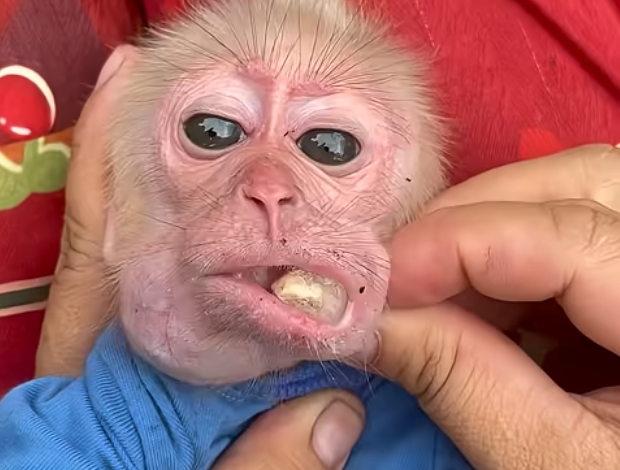
Dressed in a miniature blue Superman shirt and resting across his caretaker’s lap, infant macaque Benny undergoes a calm extraction of a lodged piece of fruit, demonstrating key aspects of primate buccal anatomy and caregiver trust.
Breakdown of the Nine-Second Rescue
Despite its brevity, the clip captures a careful, routine caretaking interaction:
- [00:00] – Identifying the Blockage: Benny lies flat on his back over his caretaker’s patterned trousers. His left cheek bulges noticeably, and a large chunk of white fruit is visible protruding from his lips.
- [00:02] – The Gentle Extraction: Using index finger and thumb, the caregiver delicately reaches into the corner of Benny’s mouth. Working with the baby’s elastic cheek tissue, they gently pry the dense white wedge of fruit free before it can pose a choking hazard.
- [00:04] – The Follow-Up Check: Once the main chunk is removed, the caretaker strokes Benny’s chin and checks around the mouth, clearing away small leftover crumbs and ensuring his airway remains entirely open.
- [00:06] – Showing the Culprit: The caregiver holds up the remaining piece of green fruit (resembling a crisp guava or wild plum) that Benny had been nibbling on, illustrating just how large a piece the infant attempted to chew off.
- [00:08] – Restored Peace: Completely unfazed by the intervention, Benny relaxes back against the handler’s hand with wide, trusting eyes.
Cheek Pouch Anatomy and Early Weaning Challenges
While the scene looks like a simple feeding accident, it highlights fundamental evolutionary traits:
- Developing Cheek Pouches (Buccal Pouches): Macaques possess expandable cheek pouches designed to store food quickly during foraging runs. In very young infants, however, muscle control and swallowing coordination are not fully matured. Dense or unyielding food items can get trapped in the lateral pouch before the monkey learns how to press them backward toward the molars.
- Weaning and Solid Food Hazards: As infant monkeys transition from milk to solids, they lack the grinding dentition needed to break down hard, fibrous fruits. Biting off chunks larger than their esophagus can handle creates an immediate risk of blockage or choking.
- Maternal Trust and Compliance: In wild troops, mother macaques frequently check their infants’ mouths, grooming away hazardous seeds, dirt, and foreign matter. Benny’s lack of resistance—keeping his jaws relaxed rather than snapping—mirrors the instinctual submission that wild infants show to their mothers during grooming.
Why the Moment Resonates
With hundreds of thousands of views, the video succeeds because of its universal relatability. Watching a caregiver calmly fish a too-large bite out of a baby’s mouth strikes an immediate chord with parents everywhere. Benny’s calm gaze and colorful superhero shirt add a layer of gentle humor to a vital moment of attentive animal care.