I. The Tarmac Stand-off at Joint Base Andrews
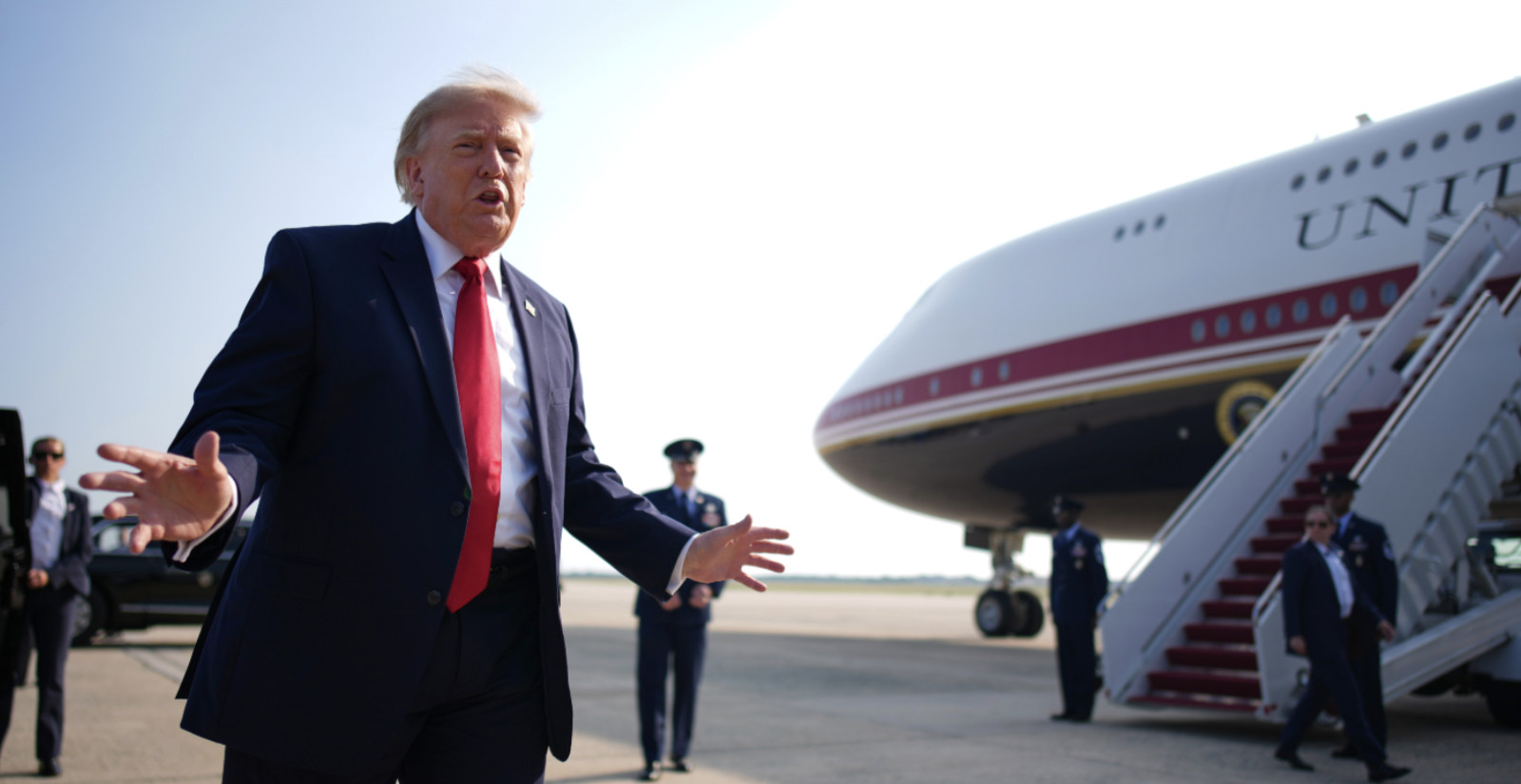
On a Saturday morning at Joint Base Andrews, the presidential logistics apparatus was moving through its familiar, rigid choreography. Secret Service sweeps had cleared the tarmac, ground crews were finishing pre-flight diagnostics on the customized Boeing 747 known to air traffic control as SAM 28000, and a small, credentialed cadre of journalists gathered at the perimeter gate to fulfill one of Washington’s oldest operational compacts: traveling as the eyes and ears of the American public alongside the Commander-in-Chief.
Among them was the broadcast crew from CNN, assigned to serve as that day’s television pool producer. In the codified machinery of presidential travel, their role was purely structural. They were not traveling to capture exclusive branding for CNN; under the decades-old pool agreement, their technical team was responsible for recording, transmitting, and sharing raw camera feeds of President Donald Trump with every major national news network, including ABC, CBS, NBC, and Fox News.
The assignment never took place.
Before the network’s videographers and producer could approach the airstairs, White House officials informed the traveling contingent that CNN had been stripped of its assigned seat. In their place, administration aides directed personnel from Real America’s Voice News—a right-leaning streaming outlet that does not participate in or fund the broadcast network pool rotation—into the press cabin. Minutes later, Air Force One departed Maryland airspace bound for Knoxville, Tennessee, where President Trump was scheduled to attend a college football game at Neyland Stadium.
The tarmac eviction did not happen in a vacuum. It was the latest escalation in an open campaign by the Trump White House to dismantle the institutional access of independent news organizations. Coming just days after a federal judge ordered the administration to halt its sweeping ban on CNN, MS NOW, and Politico, the maneuver aboard Air Force One signaled a defiant legal and operational reality: if the courts forced the administration to permit disfavored reporters onto White House grounds, the executive branch would simply ground them when the presidency took flight.
II. The Architecture of the Flying Oval Office
To understand why the exclusion of a single network from an aircraft seat sparked an immediate institutional crisis, one must understand the delicate, half-century-old mechanism of the White House press pool.
Air Force One is not a commercial charter, nor is it a conventional press bus. The VC-25A aircraft has strictly limited seating capacity for non-governmental personnel. The Secret Service, military aides, senior policy advisers, communications staff, and the flight crew occupy virtually the entire footprint of the plane. Because it is physically impossible to accommodate the hundreds of domestic and foreign reporters assigned to the White House beat, the media organizations themselves—under the umbrella of the White House Correspondents’ Association (WHCA) and the joint broadcast network consortium—created the press pool.
The system is built on shared labor, shared expense, and mandatory operational neutrality. A rotating group of 13 journalists represents the entire press corps on any domestic trip:
- A five-person television crew (producer, camera operator, audio engineer, sound technician, and lighting support) provided on rotation by ABC, CBS, CNN, Fox News, or NBC.
- Print correspondents representing wire services (The Associated Press, Reuters, Bloomberg) and major national dailies.
- Still photographers from news syndicates.
- A radio reporter.
When the designated pool reporter asks a question during a mid-flight gaggle in the press cabin, that audio is uploaded for all competitors. When the television pool camera records the President boarding or descending the airstairs, that raw 4K signal is transmitted to a shared broadcast ingest point, enabling every news organization on Earth to broadcast the visual within seconds. The news outlets themselves pay the federal government commercial first-class airfare equivalent rates for every seat occupied by their personnel on military aircraft.
Crucially, the pool operates under an unwritten constitutional armistice: the government determines how many seats are available for security and logistical reasons, but the press corps itself determines which reporters and networks occupy them based on strict, non-partisan rotation schedules.
By stepping between the rotation schedule and the aircraft door to hand-pick which network flew and which was grounded, the White House did not merely punish CNN; it asserted an unprecedented unilateral power to dictate the composition of the pool itself.
III. The Fall Escalation: Anatomy of a Retaliation
The path to the Andrews tarmac began eight days earlier, when President Trump ordered the complete revocation of press credentials for three prominent national news outlets: CNN, MS NOW, and Politico.
The stated justification from the Oval Office was swift, personal, and uncompromising. In a string of announcements across public appearances and social media posts, Trump declared that the organizations produced “negative news” designed to undermine his administration and the Republican Party heading into the midterm season.
“Fake news should not be allowed in the White House!!!” Trump posted on Truth Social. “It has gone on far too long, at a tremendous cost to our country. We want real news.”
Within hours of the directive, the administrative machinery moved with lethal efficiency. Hard passes issued to long-serving correspondents were deactivated at the North and Northwest gates of the 18-acre White House complex. Correspondents arriving for routine 6:00 a.m. security sweeps were stopped at the perimeter fence by the Secret Service and informed that their clearance had been summarily rescinded.
The targeted outlets refused to accept the expulsion quietly. Joined by first amendment litigator Theodore J. Boutrous Jr. of Gibson, Dunn & Crutcher—who had successfully represented CNN in 2018 when the first Trump administration revoked the press pass of Jim Acosta—the trio of news organizations filed an emergency lawsuit in the U.S. District Court for the District of Columbia. The complaint named President Trump, White House Chief of Staff Susie Wiles, Communications Director Steven Cheung, and Secret Service Director Sean M. Curran as defendants.
The lawsuit argued that the blanket exclusion was a textbook violation of the First Amendment’s protection against viewpoint-based discrimination and the Fifth Amendment’s guarantee of procedural due process. Decades of legal precedent established that while the White House is not required to open its doors to all journalists, once it establishes a public press briefing area, it cannot expel individual reporters based on their viewpoint or editorial coverage without notice and a formal opportunity to be heard.
The judicial response was rapid. Following an emergency hearing, U.S. District Judge Timothy J. Kelly issued a temporary restraining order compelling the White House to restore access. Kelly noted in his bench ruling that the administration had provided “no declarations or other support—classified or unclassified—explaining how any of the reporting damaged national security”.
Reporters from the three outlets returned to the briefing room. But while the administration complied with the letter of the court’s order inside the gates of 1600 Pennsylvania Avenue, it immediately sought out jurisdictional gray zones where judicial authority was less established: the mobile, closed-door perimeter of the traveling presidential motorcade and Air Force One.
IV. The Courtroom Clash: Viewpoint Discrimination vs. Executive Discretion
The White House’s legal defense of its Air Force One exclusion relies on an aggressive interpretation of executive discretion. Department of Justice attorneys and White House spokespeople argue that access to military assets and personal presidential travel is fundamentally different from attendance at a stationary briefing in the James S. Brady Press Briefing Room.
In official statements, White House Communications Director Steven Cheung and other administration officials framed presidential access not as an institutional right, but as a reciprocal relationship. They labeled major network broadcasts as “performative and dishonest,” asserting that a sitting president maintains the unreviewable prerogative to decide who is granted proximity on military aircraft during domestic political travel.
The press corps’ legal team counters that this argument collapses under existing D.C. Circuit case law:
+---------------------------------------------------------------------------------------------------+
|                        Key Legal Precedents in White House Access Litigation                      |
+--------------------------+-----------------------+------------------------------------------------+
| Precedent Case           | Court / Year          | Central Legal Finding                          |
+--------------------------+-----------------------+------------------------------------------------+
| Sherrill v. Knight       | D.C. Circuit (1977)   | The Secret Service cannot deny press passes    |
|                          |                       | arbitrarily; clear, published standards and    |
|                          |                       | due process protections are required.          |
+--------------------------+-----------------------+------------------------------------------------+
| CNN v. Trump             | U.S. Dist. D.C. (2018)| Revoking a pass without notice or hearing      |
|                          |                       | violates Fifth Amendment due process.          |
+--------------------------+-----------------------+------------------------------------------------+
| Karem v. Trump           | D.C. Circuit (2019)   | Viewpoint-based suspension of credentials      |
|                          |                       | violates the First Amendment; unwritten rules  |
|                          |                       | cannot be weaponized retroactively.            |
+--------------------------+-----------------------+------------------------------------------------+
| CNN, MS NOW & Politico   | U.S. Dist. D.C. (2026)| Administration enjoined from viewpoint bans;  |
| v. Trump                 |                       | lack of evidence showing national security risk|
+--------------------------+-----------------------+------------------------------------------------+
Boutrous pointed out that the government’s actions violated the core principle laid out in Sherrill v. Knight nearly fifty years ago: once the executive branch creates a system of credentials for journalists, it cannot manipulate that system to reward friendly coverage and punish critical scrutiny.
“The White House is persisting in unpredictably and inconsistently implementing the President’s unconstitutional ‘ban on the free press’ by barring CNN from fulfilling its role as a designated television network pooler—to the detriment of CNN, its fellow pool members and, ultimately, the American public,” Boutrous said in a formal court filing following the flight.
The legal danger for the administration is the paper trail. In previous disputes over White House access, government lawyers typically attempted to justify suspensions by citing behavioral infractions, breaches of decorum, or security protocols. Here, the public record is dominated by President Trump’s explicit public assertions that the media outlets were targeted directly for the editorial tone of their reporting. Under Supreme Court doctrine dating back to New York Times Co. v. Sullivan and Near v. Minnesota, explicit government punishment predicated on unfavorable editorial content is the purest form of viewpoint discrimination—an offense that receives strict scrutiny from the bench.
V. The Rise of Parallel Access and Echo Chambers
The decision to replace CNN aboard Air Force One with Real America’s Voice was not an accidental staffing improvisation. It reflects a calculated structural strategy that has gained momentum across recent election cycles: the systematic bypassing of legacy oversight bodies in favor of ideologically sympathetic digital and streaming networks.
Over the past decade, alternative media networks have established prominent footholds in Washington. Outlets like Real America’s Voice, One America News (OAN), and Newsmax do not operate within the traditional consensus framework that governed twentieth-century press relations. While traditional networks prioritize detached interrogation and adversarial follow-ups, sympathetic streaming operations routinely treat presidential coverage as celebratory or supportive political commentary.
For the Trump communications shop, substituting a legacy network with a friendly outlet offers distinct advantages:
- Control of the Visual Frame: Legacy pool cameras are operated by unionized union photojournalists trained to maintain objective framing, keep lights steady, and capture unvarnished reality—including moments of confusion, physical hesitation, or hostile interactions with crowds or aides. An aligned streaming channel is far more likely to produce favorable compositions.
- Elimination of Unscripted Friction: Mid-flight press gaggles on Air Force One are intimate and intense. Reporters stand crammed in the narrow aisle of the press cabin, firing pointed questions about foreign policy, classified operations, or judicial scandals directly at the President or his press secretary. Replacing persistent interrogators with ideological loyalists neutralizes the threat of uncomfortable headlines emerging from the cabin.
- De-legitimization of the Institution: By demonstrating that an internationally recognized news organization can be expelled from the presidential flight and replaced with an online broadcaster without halting the trip, the White House reinforces its ideological narrative to its core electorate: that the traditional media is obsolete, corrupt, and subject to presidential authority.
When Air Force One touched down at McGhee Tyson Airport in Alcoa, Tennessee, the real-world impact of the switch was immediately apparent. Thousands of football fans observed the presidential jet’s low-altitude flyover above Neyland Stadium. But back in Washington and New York, control rooms at CBS, NBC, and ABC scrambled. The pristine, synchronized broadcast pool transmission they had relied upon for decades was missing.
VI. Operational Breakdown and the Pool Dilemma
The eviction of CNN exposed the fragile technical interdependence of modern newsgathering. While politicians frequently treat “the media” as a monolithic, rival political faction, the operational reality of the press corps is defined by complex, expensive logistics that require fierce competitors to collaborate daily.
Major television networks maintain high-capacity fiber lines, microwave relay trucks, satellite uplink suites, and multi-million-dollar editing hubs in Washington, Joint Base Andrews, and traveling field locations. When a network takes its turn as the TV pooler, it deploys this massive infrastructure to benefit everyone.
When Real America’s Voice was abruptly designated to fill the pool seat, the downstream transmission process broke down:
- Technical Incompatibility: Real America’s Voice did not possess the contractual access, satellite transponder leases, or distribution infrastructure necessary to beam standard, low-latency, broadcast-grade master feeds to ABC, NBC, CBS, Fox, and CNN.
- Editorial Disruption: Network producers were forced to monitor secondary feeds, relying on makeshift social media clips, local station feeds from Knoxville, or delayed handheld video. Press events around the presidential visit suffered immediate technical hitches and transmission blackouts.
- The Solidarity Dilemma: The incident placed other major news organizations in an agonizing professional bind. When the White House initially banned CNN, MS NOW, and Politico from the physical briefing room, other network pool providers demonstrated solidarity by declining certain pooled duties in protest. But boycotting the pool entirely poses a grave journalistic danger: an empty pool seat means the American public has no independent verification of the President’s public movements, health, or statements in transit.
The White House Correspondents’ Association finds itself walking a razor’s edge. If the association boycotts presidential coverage, it surrenders the public’s access to the chief executive. If it accepts the administration’s right to dictate pool membership, the pool ceases to be an independent instrument of a free press and becomes an arm of executive stage management.
VII. An Executive Beyond Scrutiny
The battle over Air Force One’s press cabin marks a profound shift in American political accountability. For generations, through the Vietnam War, the Watergate scandal, the September 11 terrorist attacks, and the height of the COVID-19 pandemic, American presidents of both parties accepted the uncomfortable presence of the press pool.
They did so not out of affection for the reporters who challenged them, but out of recognition of a basic democratic compact: in a nuclear-armed constitutional republic, the head of state must never travel completely shielded from independent scrutiny. If an international crisis erupts while Air Force One is halfway across the Atlantic, the pool reporter’s notebook and camera are the historical record for the citizens who pay for the flight.
By treating a seat on Air Force One as an executive favor to be granted to allies and denied to critics, the White House seeks to rewrite that compact. As attorneys for CNN, MS NOW, and Politico return to the federal courthouse to seek permanent injunctions against these travel restrictions, the underlying question reaches far beyond the seating chart of an airplane. The dispute strikes at the heart of whether an American president can use the immense powers of his office to insulate himself from accountability, turning public visibility into a privilege awarded only to those who promise not to look too closely.