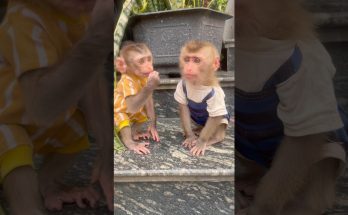
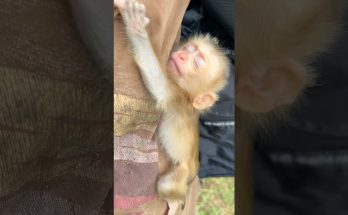
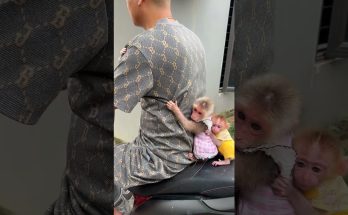
The infant monkey’s eyes are wide and fixed on the camera. A gloved hand steadies its small body against a folded absorbent pad, the kind used in veterinary clinics or home nurseries. Behind the pair, a diagnostic ultrasound machine glows on a rolling cart, and a cardboard box labeled “oxygen concentrator” sits stacked against the wall.
The scene looks clinical. Whether it is one is harder to say.
A short vertical video posted to YouTube Shorts, titled to suggest the young macaque “looked worried” during an examination by a doctor, shows roughly the same sequence repeated across its short runtime: a person in a surgical cap, mask, and dark scrub top holds the infant monkey, turning its limbs and torso while it grips at the fabric and the handler’s fingers. The clip carries hashtags for “monkey,” “baby monkey,” and the Vietnamese word for “pet.”
No caption, description, or audio transcript was publicly available for the video, so the narration, the handler’s words, and the monkey’s history are not confirmed. What can be described is only what the still frames show: a small primate, likely only weeks or a few months old, held upright and then laid against the padding while an adult human hand inspects it.
What the Footage Shows — and What It Doesn’t
Infant macaques have distinctive features that make their age easy to estimate even from a few frames: large eyes relative to the skull, thin limbs, and sparse fur around the face and hands. The animal in this video fits that profile. Its species cannot be confirmed with certainty from still images alone, though long-tailed macaques are the animal most frequently kept and filmed this way across Vietnam and neighboring countries.
The room includes equipment associated with a small medical or veterinary setting — the ultrasound unit, the oxygen concentrator box, a spray canister, and what appears to be a stainless steel table. Whether this is a licensed veterinary clinic, a home setup built to resemble one, or something in between cannot be determined from the frames provided.
The video’s own title frames the monkey as “worried.” That is the uploader’s description, not something that can be independently verified from a handful of still images. Infant macaques do vocalize, grip tightly, and show facial tension when restrained or handled by unfamiliar hands, and several of the frames show the animal’s fingers curled around the handler’s fingers or the surrounding cloth — a grasping reflex common in young primates seeking something stable to hold.
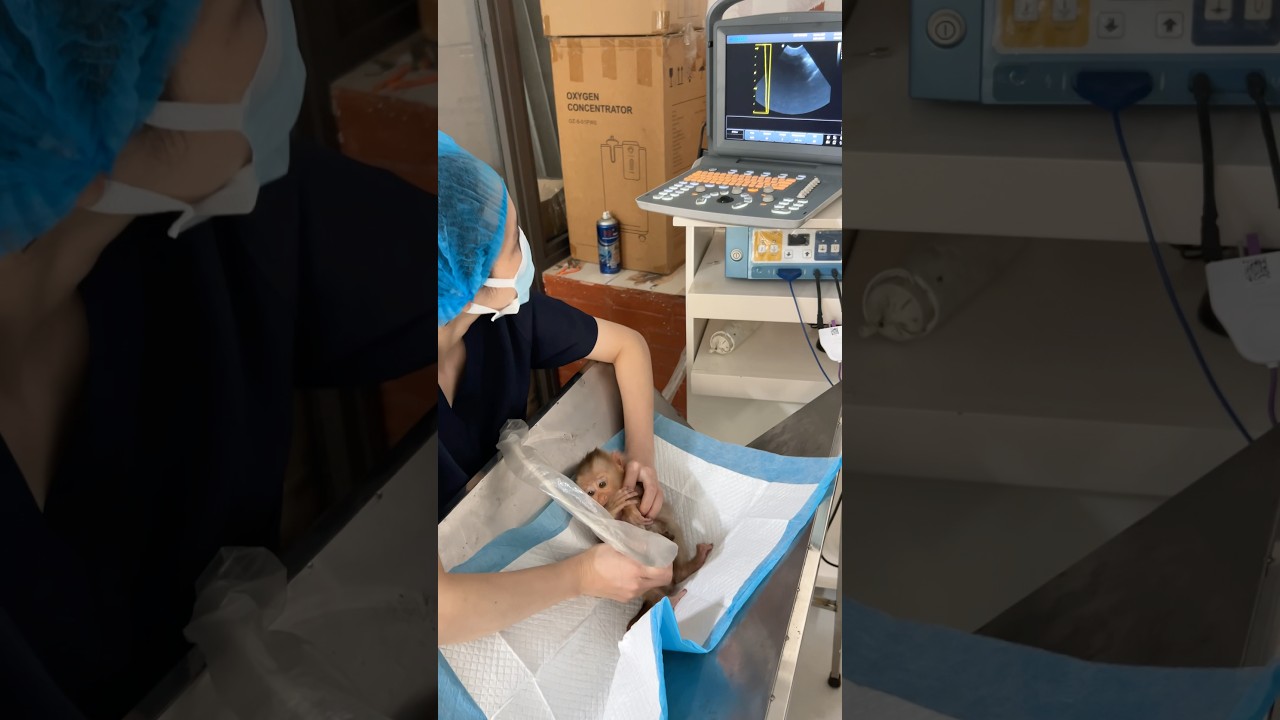
Across the frames supplied from later in the clip, the sequence repeats: the infant is lifted, inspected, and settled back against the pad. There is no visible sign in these frames of the animal being struck, restrained violently, or in acute distress beyond the ordinary tension of being handled. At the same time, there is no confirmation of what happens before or after the segments shown, what the examination was for, or who the handler is.
A Familiar Genre Online
Videos like this one sit inside a much larger and well-documented category of content. Over the past several years, researchers and animal welfare organizations have tracked a surge of social media channels, many based in Vietnam and Cambodia, that feature infant macaques raised in home-like settings and filmed in everyday human scenarios — eating, bathing, dressing, and visiting staged “doctor” exams.
A 2025 analysis from the Singapore-based outlet Fulcrum found that these channels upload multiple videos daily featuring infant macaques trained to perform human-like behaviours on camera, often under duress, including wearing baby clothes, eating junk food, interacting with toys or small animals, and walking bipedally as a child would. The same report noted that scenarios are often recycled with slight variations to maximize content output, and that these channels evade legal action by registering their YouTube channels outside the country where the filming happens, exploiting jurisdictional gaps in animal cruelty enforcement.
The animal welfare group Lady Freethinker, working with Action for Primates, sent investigators into this industry in Cambodia and reported that owners kept animals in cramped, barren wire cages with no access to food and water, displaying stress-based behaviors once the cameras were off. Separately, a multi-year review by the Asia for Animals Social Media Animal Cruelty Coalition found that videos by pet macaque owners had a total of 12.05 billion views online, with 12 percent of these videos involving intentional physical torture, 13 percent involving psychological abuse, and 60 percent involving direct physical abuse.
None of that research describes this specific video or channel, and nothing in the frames provided here shows the kind of mistreatment those reports document. It would be inaccurate to extend those findings onto an individual clip without evidence. But the format — an infant macaque, a home-style setting, a staged medical narrative, a title built to draw concern and clicks — closely mirrors the pattern researchers have flagged repeatedly as a monetized online genre built around wild animals young enough to still need their mothers.
Why Wild Monkeys Don’t Belong in Living Rooms
Macaques are not domesticated animals. In the wild, infants typically stay in constant physical contact with their mothers for the first months of life, nursing frequently and depending on the group for protection, warmth, and social learning. An infant separated from its mother and raised by humans misses nearly all of that development.
There are also direct health risks for people. The U.S. Centers for Disease Control and Prevention has long warned about herpes B virus, a pathogen carried by most adult macaques. A CDC-affiliated study concluded plainly that B-virus infection is highly prevalent, 80 to 90 percent, in adult macaques and may cause a potentially fatal meningoencephalitis in humans, a risk that makes macaques unsuitable as pets. Infant macaques carry lower rates of the virus than adults, but the same research found a common pattern of children being bitten far more often than adults in households that keep them.
In most of the United States, keeping a macaque as a private pet is already restricted or banned outright under state exotic-animal laws, and in much of Southeast Asia, capturing or possessing wild macaques without a permit is illegal as well — even where enforcement is inconsistent.
What the Camera Doesn’t Answer
The video gives viewers an infant monkey’s face, a handler’s careful hands, and a title that tells them how to feel about what they’re watching. It does not give them the animal’s origin, its living conditions off camera, or confirmation that what looks like a medical exam is one.
That gap is worth sitting with. A curious, wide-eyed baby animal is an easy thing to love from a phone screen. Understanding where it came from, and what its daily life away from the camera actually looks like, is a harder and more honest question — and, according to the researchers who have spent years looking into this exact kind of content, usually the more important one.