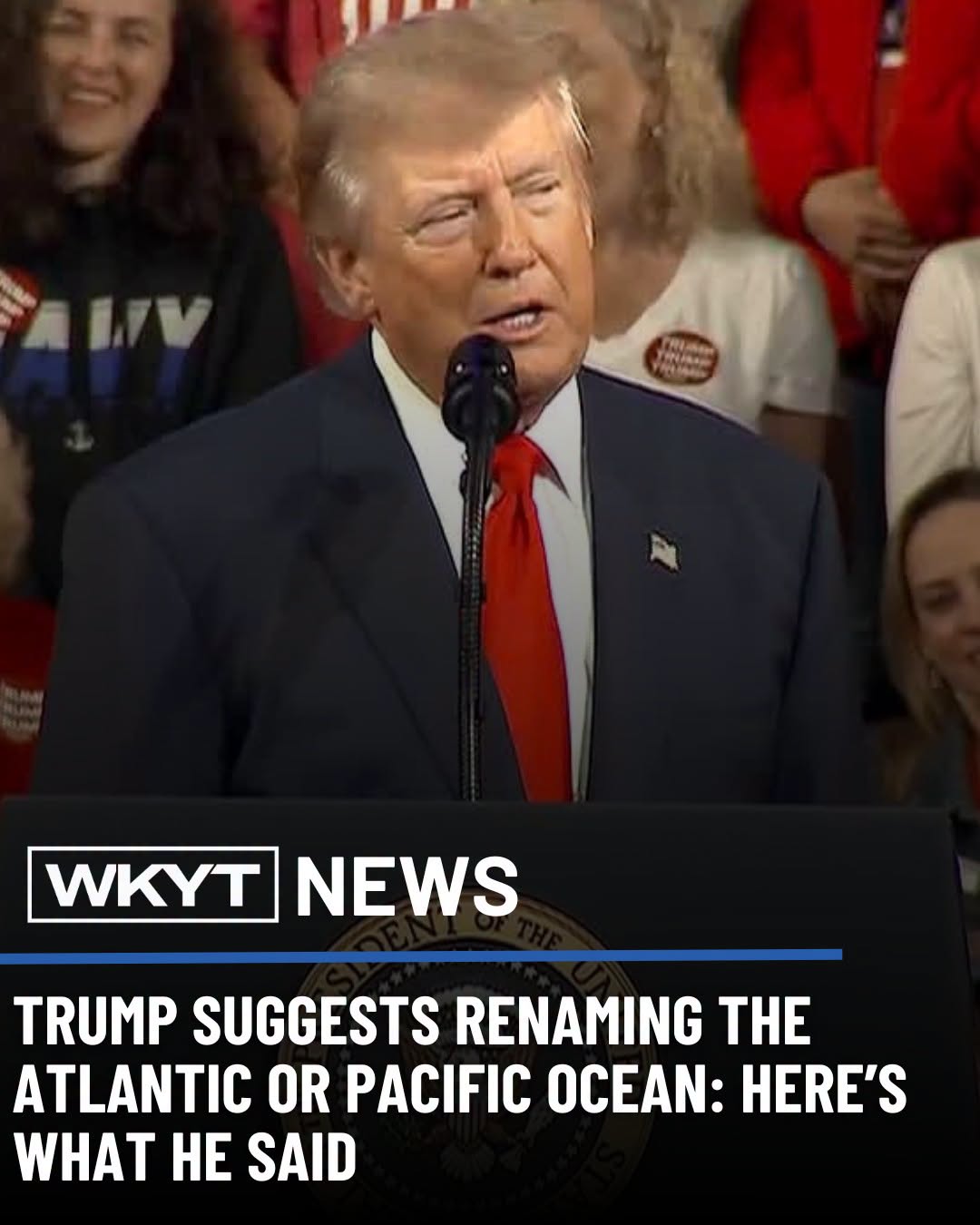
President Donald Trump suggested over the weekend that the United States should rename the Atlantic or Pacific Ocean, floating “Trump Ocean” as one possible new name during a campaign rally in Tennessee.
“We could call it Trump Ocean or Ocean of the Americans. Something like that … We have to. We should have before I get out,” Trump told the crowd Saturday.
The remark came as Trump campaigned in Clarksville, Tennessee, for Senator Bill Hagerty and gubernatorial candidate Marsha Blackburn, part of a wide-ranging rally that also featured musician Kid Rock. It was the latest in a string of efforts by the president to change the names of major geographic features since returning to office.
Part of a broader renaming campaign
The ocean idea did not come out of nowhere. Trump has already renamed the Gulf of Mexico the “Gulf of America” through an executive order signed shortly after his January 2025 inauguration, and in August 2026 he signed a separate order changing Lake Ontario’s name to “Lake America” amid an escalating trade dispute with Canada.
At the Tennessee rally, Trump tied the ocean idea directly to those earlier moves, telling the crowd the country now needs a river and an ocean to go along with its renamed gulf and lake. He offered “Ocean of the Americas” as an alternative to naming the body of water after himself.
Despite the suggestion, Trump ruled out renaming two of the country’s most prominent rivers. He said he would leave the Hudson River’s name untouched, crediting explorer Henry Hudson by saying, “He did a good job of setting up that sucker a long time ago.” He also said he would not touch the Mississippi River’s name, telling the crowd, “Now, I’m not changing the name of the Mississippi. I love Mississippi. We won that state by so much.”
What the president can — and can’t — actually do
As president, Trump can use executive authority to change how federal agencies refer to bodies of water and other geographic features within U.S. jurisdiction. That authority is how the Gulf of Mexico came to appear as “Gulf of America” on federal maps and how Lake Ontario was ordered changed to “Lake America,” with the Interior Department directed to update the Geographic Names Information System accordingly.
But that power has real limits. An ocean spanning multiple countries and international waters is a different matter than a lake bordering two nations or a gulf bordering the U.S. and Mexico. No single country, including the United States, can unilaterally rename an ocean for the rest of the world, and there is no international body with authority to enforce a new name globally. Even with Lake Ontario, Canadian officials have made clear they will keep calling it by its original name regardless of what U.S. federal maps say.
Canadian Prime Minister Mark Carney said at the time that Canadians would continue referring to the lake as Lake Ontario “then, now and always,” and Ontario’s premier dismissed the rebranding as political theater before it was formally signed.
Trump offered no formal proposal or timeline for an ocean name change at the Tennessee rally, and the White House has not announced any executive action on the idea. The comment appeared to be an extension of his pattern of floating renaming ideas at public events before sometimes following through with formal orders, as he did with Lake Ontario after first raising it in social media posts and public remarks.
Why it matters
The renaming push has become a recurring flashpoint in Trump’s second term, drawing both mockery and genuine policy consequences. The Gulf of Mexico name change led to a public standoff with The Associated Press, which was temporarily barred from the Oval Office and Air Force One after it continued referring to the “Gulf of Mexico” in its reporting. The Lake Ontario renaming became entangled in an active trade war with Canada, with Interior Secretary Doug Burgum framing it as part of reflecting “the greatness of the United States” along the northern border.
Whether an ocean name change would trigger similar friction remains to be seen, since Trump has not signed any order or outlined a specific process for it. For now, the idea exists only as a rally applause line, though his past comments on the Gulf of Mexico and Lake Ontario both preceded formal executive orders within weeks or months.
What happens next
There is no confirmed timeline for any formal action on an ocean renaming. Based on the pattern with the Gulf of Mexico and Lake Ontario, any next step would likely involve an executive order directing federal agencies, such as the Interior Department’s Board on Geographic Names, to begin using a new name on official U.S. government maps and documents. Such a change would apply only to federal usage within the United States and would not be binding on other countries, mapmakers, or international organizations.